
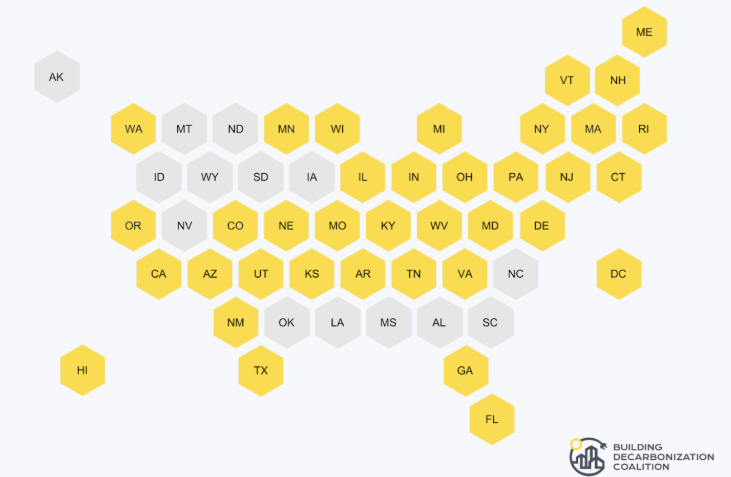
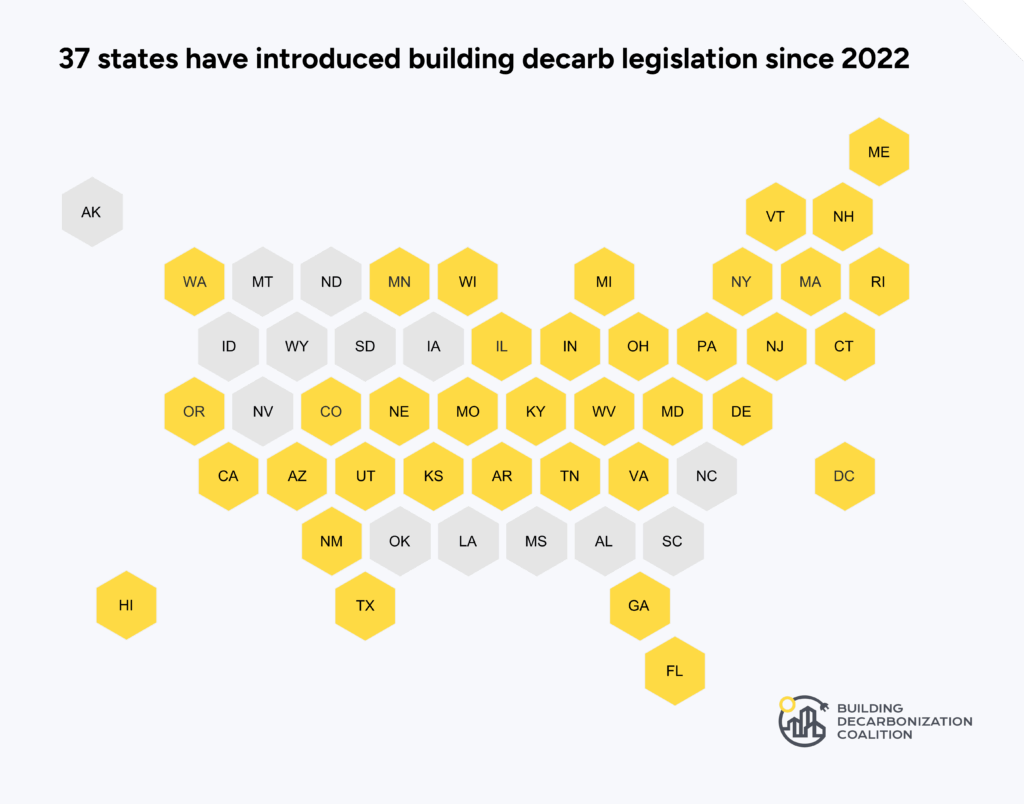
In BDC’s fourth annual legislative roundup, we identified 130 bills in 27 states that would further building decarbonization. Before diving into the 2025 trends, we look back at the progress building decarbonization has had over the past four years. Since 2022, when BDC started tracking and analyzing national trends in building decarbonization legislation, we’ve clocked 456 bills that were filed in 37 states. Of these 456 bills, 165—over a third—became law.
Several trends have emerged since 2022. While many of the bills we initially tracked during our first legislative roundup fell primarily into broader energy categories such as building codes and efficiency, we have since seen the proliferation of new and innovative topics like Thermal Energy Networks, the Future of Gas, and Neighborhood-Scale Decarbonization. Recently, we’ve also seen emerging bills supporting Obligation to Serve reform, Clean Heat Standards, and AC-to-Heat Pump policies, demonstrating an expansion of solutions for issues such as energy affordability and access to emissions-free heat. This continual evolution of clean energy solutions shows that building decarbonization is maturing as a movement, bringing with it shared knowledge and consensus on where to go next.
2025
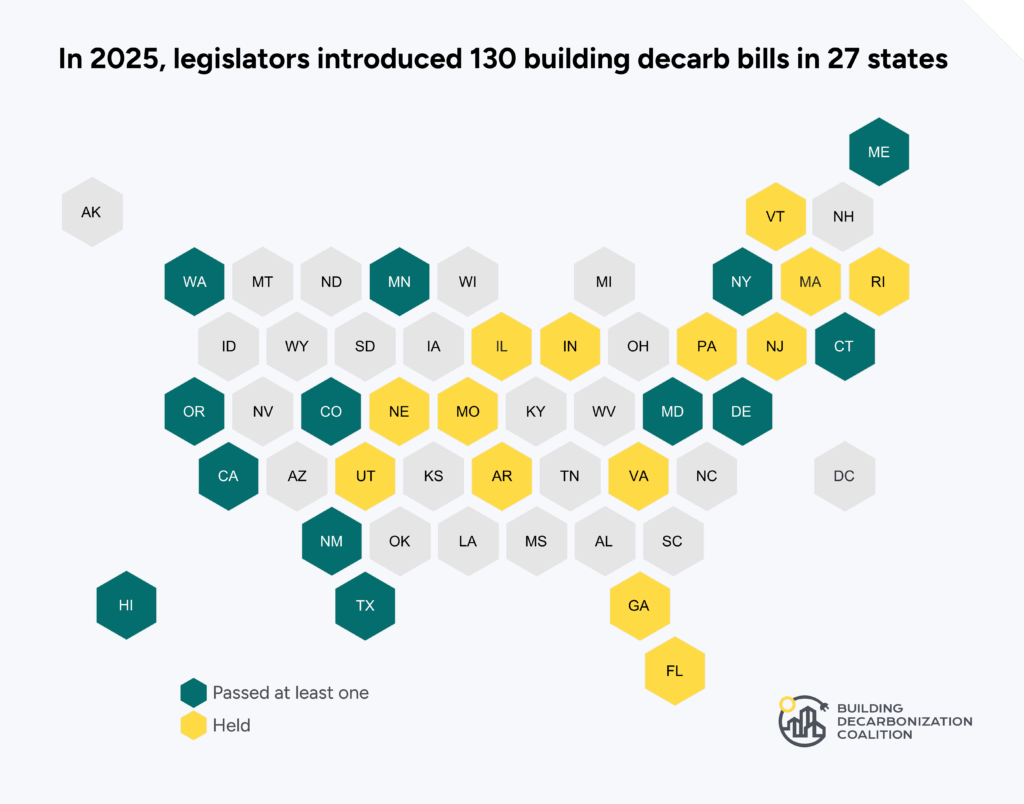
In the 2025 legislative session, we tracked 130 bills and budget items promoting building decarbonization. Out of these 130 bills, 40 passed. Additional bills may pass this year, as 15 bills are still being considered across Massachusetts, New Jersey, and Pennsylvania. Illinois also has a special session that may see the passage of the energy omnibus bill.
In particular, we saw a number of bills shaping what the managed transition away from gas and towards clean energy looks like. These four focus areas are:
- Market Acceleration: As heat pump market share continues to grow, supportive policies are essential to accelerate this progress and ensure that the market for clean technologies adapts to evolving social and economic realities.
- This year we saw 29 bills in 14 states that support Market Acceleration. Of these, 12 passed.
- The bills this year sought to make energy more affordable, create statewide navigators, focus on reducing costs through bulk purchasing, and strengthen state leadership for affordable clean energy programs.
- Future of Gas: These policies aim to create thoughtful, long-term plans to address business-as-usual capital investments, rising stranded asset risk, escalating customer bills, and the inequitable distribution of methane pollution are essential to ensuring that gas customers can seamlessly transition onto clean energy infrastructure and that states meet their climate goals.
- This year 9 bills in seven states (CT, IL, IN, MA, MD, NM, and NY) introduced bills that address the Future of Gas. Of these bills, 3 passed.
- The bills this year sought to cap gas utilities’ spending, reform the obligation to serve, ensure that existing gas customers aren’t subsidizing new customers’ new gas line extension allowances, and review online pipeline replacement programs to fund non-gas-pipeline alternatives (NPAs).
- Future of Heat: These policies encourage the infrastructure, technologies, and programs we can scale while we wind down the methane gas system.
- This year, we saw 26 bills in 15 states that proposed innovative and equitable solutions for building out the solutions side of our clean energy transition. Of those, 6 passed.
- The bills proposed this year sought to develop thermal energy networks as a neighborhood-scale clean energy solution, utilize waste energy from data centers as a resource, enact clean heat standards that obligate gas utilities to implement measures like electrification, heat pump technology, efficiency, thermal energy networks, and sometimes RNG and hydrogen, in order to deliver an increasingly clean heat supply, and create workforce training programs and implement workforce agreements that help grow a skilled clean energy workforce.
- Neighborhood Scale: policies that advocate for a scaled-up, community-oriented approach to building decarbonization.
- 17 bills across 11 states proposed policies to support a neighborhood-scale transition off the gas system, 4 of which have passed. With 4 new TENs bills passed this year, now nearly one in four states has passed legislation to study, support, or implement this innovative, neighborhood-scale clean energy infrastructure.
- The bills proposed this year sought to mandate neighborhood-scale thermal energy network pilot projects with a focus on environmental justice and just transition standards, require gas and electric utilities that share a service area to collaborate on annual thermal transition plans, and establish regulatory oversight for thermal energy companies and maintain gas companies’ priorities to develop thermal energy network pilot projects.
2025 saw significant progress in the four focus areas of Market Acceleration, Future of Gas, Future of Heat, and Neighborhood Scale. In particular, the bills this year moved the needle on providing funding opportunities for heat pumps, thermal energy networks, and other clean energy technologies. As these ideas continue to spread, we expect to see these trends and areas of progress to continue to grow in the upcoming years.
Curious to learn more about other trends we identified? Check out the rest of our analysis here (which is best viewed on a computer, not a mobile device). You can also explore the bill details on google sheets (along with bills from 2024, 2023, and 2022).