

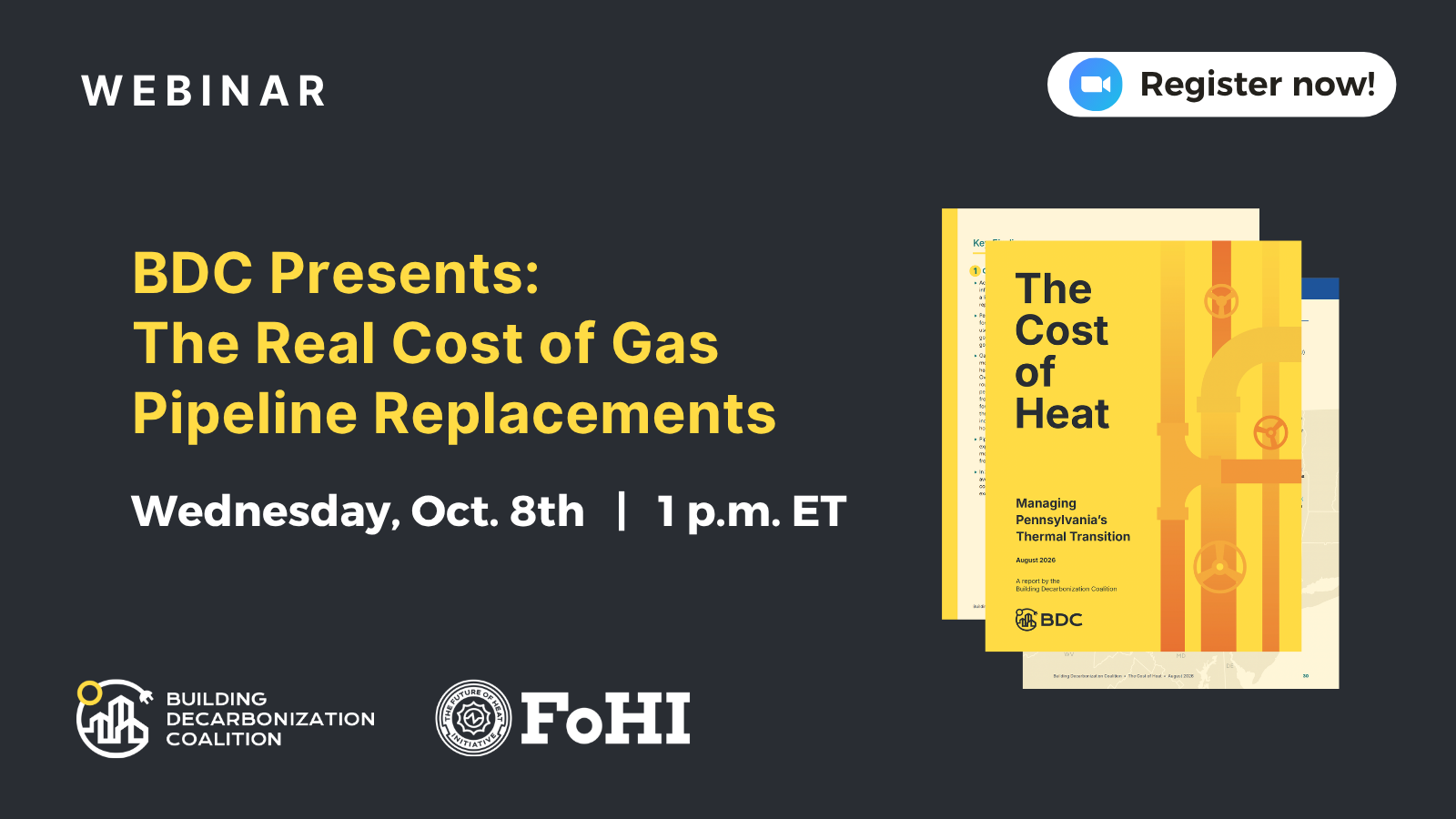
Join the Building Decarbonization Coalition and the Future of Heat Initiative on Thursday, Oct. 8, for a discussion of the mounting costs and safety outcomes of accelerated gas pipeline replacement programs.
As many as 43 states and Washington, D.C. have had some form of accelerated replacement program, many established or expanded following high-profile pipeline safety incidents and a federal “Call to Action.” By allowing gas utilities to recover capital costs from customers more quickly, often through monthly bill surcharges, these programs have helped accelerate spending on gas infrastructure. Nationwide, 71% of a typical customer’s gas bill now goes toward gas pipelines, while 29% pays for the gas itself.
More than a decade later, the costs continue to mount. BDC’s recent report, The Cost of Heat: Managing Pennsylvania’s Thermal Transition, finds that Pennsylvania’s six largest gas utilities have spent $11 billion through Act 11-enabled accelerated replacement programs since 2013. New research from the Future of Heat Initiative also finds that accelerated replacement programs have not produced meaningful improvements in pipeline safety.
Using Pennsylvania and Massachusetts as case studies, we’ll examine how states can reform these programs to better target safety investments, strengthen regulatory oversight, protect customers from unnecessary costs, and require consideration of non-pipeline alternatives.
Speakers
- Kristin George Bagdanov, Associate Director of Research, Building Decarbonization Coalition
- Justin Gundlach, General Counsel & Director of Research, Future of Heat Initiative
- Tiffany Vu, Associate Manager of Research, Building Decarbonization Coalition