
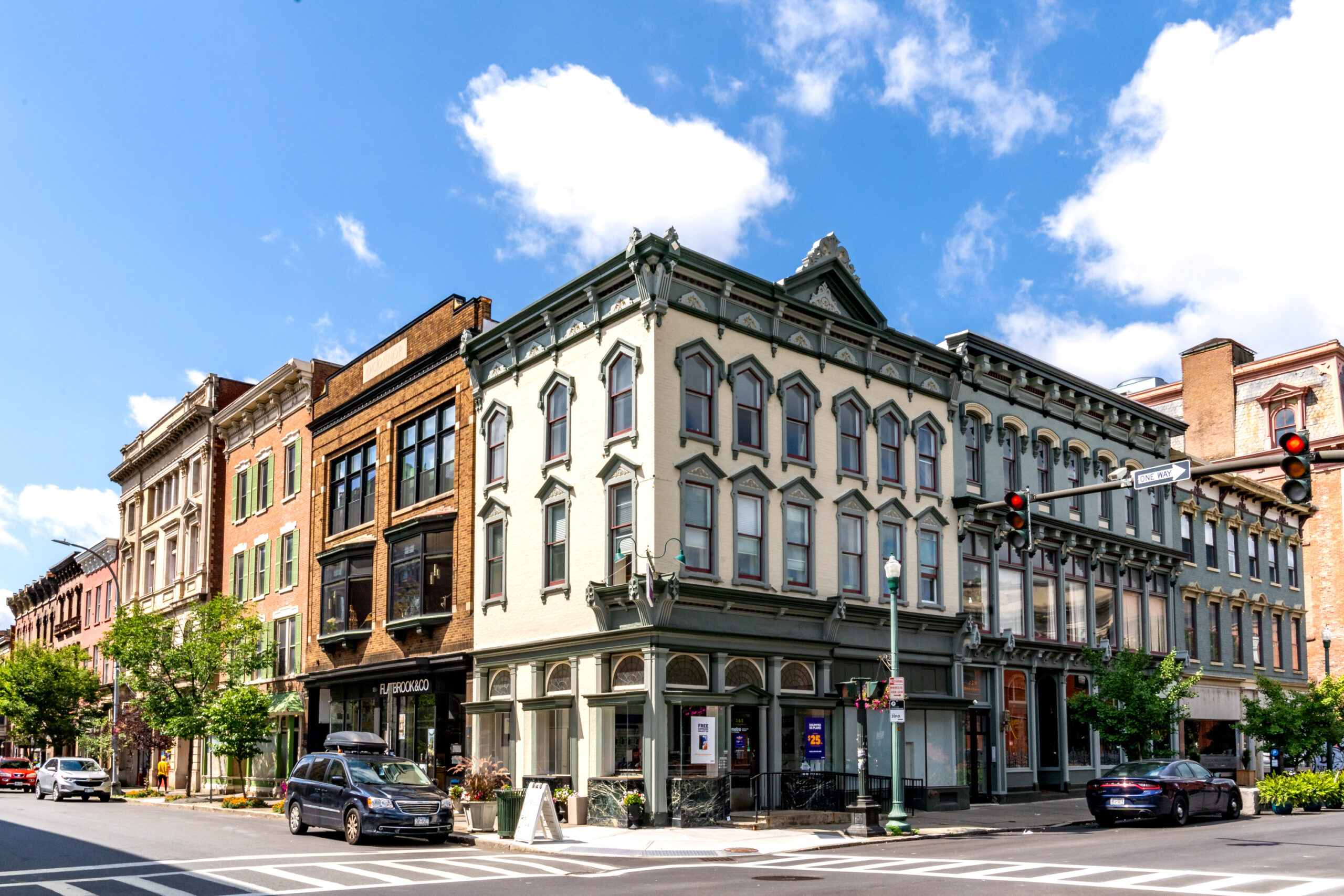
How thermal energy networks and better gas system transition policies can grow New York’s economy while ensuring the state meets its climate goals
By Allison Considine, BDC’s Senior Campaigns & Communications Manager, New York
New York is in the midst of creating a new State Energy Plan, due at the end of 2025, which is a foundational document that is designed to inform policymaking on New York’s energy needs and priorities over the next fifteen years. This Plan provides an important roadmap for how New York will meet its energy needs—but it should also lay out the pathway for New York to fulfill its legal commitments to climate mitigation and decarbonization. The final version of the plan should help align emission targets from the Climate Leadership and Community Protection Act with plans for energy infrastructure, clean technology deployment, and affordability.
To achieve the state’s legally mandated target of cutting greenhouse gas emissions 85% by 2050, New York must swiftly enact a paradigm shift in confronting one of its greatest challenges: decarbonizing millions of buildings across the state in just 25 years, to make sure that by 2050, 85% of New York buildings are using clean heating and cooling technologies, like heat pumps and thermal energy networks. To date, most of the policies in New York State have focused on decarbonizing individual structures, taking a house-by-house approach to building electrification.
While this is a good start, New York needs to scale decarbonization solutions beyond a building-by-building model to ensure that the state can rapidly and successfully decarbonize its building stock while unlocking the energy affordability, grid reliability, and economic development benefits that can come from a neighborhood-scale approach.
New York needs a paradigm shift—a move from a building-by-building approach to a neighborhood-scale approach.
The Building Decarbonization Coalition’s New York team provided detailed feedback on the Draft Plan, and organized key stakeholders to build alignment around the top policy priorities that should be in the final State Energy Plan to advance building decarbonization in New York State. Alongside our partners, we advocated for additional policies that were missing or fell short in the Draft Plan, which the state should include in the final Plan to help New York meet its emissions and decarbonization targets.
Why Neighborhood-Scale Decarbonization Matters
In response to the Draft State Energy Plan, BDC called for increased focus on neighborhood-scale decarbonization as the best method to achieve New York’s goals. By focusing on street segments, developments, or entire neighborhoods, New York can strategically retire aging gas infrastructure and redirect billions of dollars away from fossil fuel systems into clean energy solutions. This approach allows us to:
- Move faster by deploying solutions at scale rather than piecemeal.
- Make this transition fairer by protecting low-income households, who are too often left behind in one-off approaches.
- Lower costs by tapping economies of scale that make clean energy transitions more affordable for everyone.
- Support thousands of union jobs across New York.
Neighborhood-scale strategies also drive economic growth in clean energy industries while strengthening our communities against climate impacts and supporting economic growth.
Thermal Energy Networks: A Prime Example
Among the most promising models for neighborhood-scale decarbonization are thermal energy networks (TENs). These are hyper-efficient systems that heat and cool buildings and reduce demand on the electric grid by moving thermal energy to and from buildings and thermal energy sources and sinks, sharing thermal energy through connected buildings. They have multiple design possibilities that allow for different types of sources and sinks of thermal energy, including geothermal, bodies of water, waste heat from buildings and industrial processes, wastewater energy transfer, and wastewater heat recovery. TENs can be designed entirely fossil fuel-free and are a major tool in the toolkit to achieve building and neighborhood-scale decarbonization.
Importantly, TENs reduce demand on the electric grid and create resilient, future-proof communities. They embody exactly the kind of bold, practical solutions New York needs to champion in its State Energy Plan. BDC and leading industry associations, businesses, and advocacy groups celebrated proposals in the Draft Plan to develop a Thermal Energy Roadmap for New York, for the PSC to continue to develop the regulatory framework for TENs to build market certainty, and to advance analysis of TENs and grid benefits and resources to support communities in advancing TENs projects. We also called on the Energy Planning Board to include additional policies to help build and scale thermal energy networks and thermal storage as an effective decarbonization tool that promotes long-term energy affordability, sustainable jobs, and effective demand management.
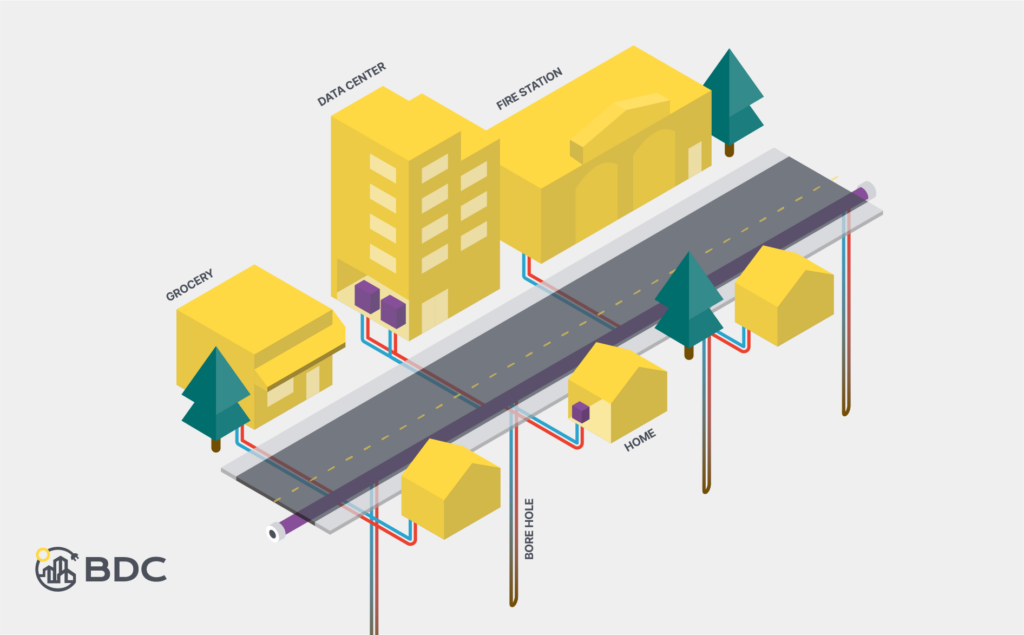
Here, the thermal energy resource is the earth, accessed through shallow boreholes. A pipe loop (in purple) connects to geothermal heat pumps (purple, on the sides of buildings) to heat and cool.
How the Draft New York State Energy Plan Should Be Improved
The Draft State Energy Plan proposes a series of strong recommendations for how New York can power a green energy future, but we know that we can and must go further. To meet this moment and ensure alignment with New York’s CLCPA mandates, the state should:
- Stop incentivizing gas system investments that lock us into fossil fuels and delay our transition to clean energy.
- Create regulations that mandate the capture and reuse of waste heat, and incentivize developers to use excess heat in their structures.
- Be bold, and double the state’s storage target to 12 gigawatts, with half dedicated specifically to thermal storage.
- Fully incorporate the Climate Action Council’s Scoping Plan recommendations, which are essential to meeting New York’s legal climate commitments.
The Path Forward
Neighborhood-scale decarbonization is the most effective method of decarbonizing our structures, adding capacity to the grid, and reducing our energy consumption at scale quickly. By embracing this approach, we can create healthier, more resilient, and more affordable communities powered by family-sustaining jobs across the state.
The State Energy Plan is a chance for New York to once again lead the nation—not just with ambition, but with action. To get there, we need to embrace solutions that match the scale of the challenge before us.
It’s time to move beyond patchwork fixes and start building a clean energy future, block by block, neighborhood by neighborhood.
Read BDC’s full comment on the Draft New York State Energy Plan