

An aerial view of Whisper Valley. Image credit: Ecosmart Solution.
|
Quick stats:
|
“As long as we are facing the pressure of higher energy costs, people will look for ways to control their living expenses. We’re trying to help them control their energy bills and make them predictable.”
Chris Gray, Chief Executive Officer, Ecosmart Solution
Whisper Valley Weathers the Storms
In February 2021, three winter storms converged on Texas, resulting in the country’s largest blackout in nearly two decades. More than 3 million homes and businesses lost power, including, briefly, homes in Whisper Valley, a master-planned community in East Austin.
But once power was restored to the nearby substation, Whisper Valley’s geothermal heat pumps quickly warmed homes without triggering the surge in electricity demand that had plagued Texas’s grid for days.
Whisper Valley homes are heated and cooled by the GeoGrid™, a thermal energy network (TEN) owned and operated by Ecosmart Solution. Because its pipes are installed below the frostline, the GeoGrid™ never froze, and heat pumps could get back to work without demanding much energy.
“Because the GeoGrid stayed well above the outdoor temperature, homes were able to maintain their interior temperature,” explains Chris Gray, Chief Executive Officer of Ecosmart Solution. “Other places might have been struggling to heat because their equipment was either turned off for a long time, or it was trying to operate at very, very low ambient temperatures.”
The system showed its resilience again two years later. A January 2023 ice storm knocked out power for six hours. After it returned, the GeoGrid™ again warmed homes efficiently. In fact, homeowners with backup batteries could continue running their heating, refrigeration, and some appliances without any interruption at all.
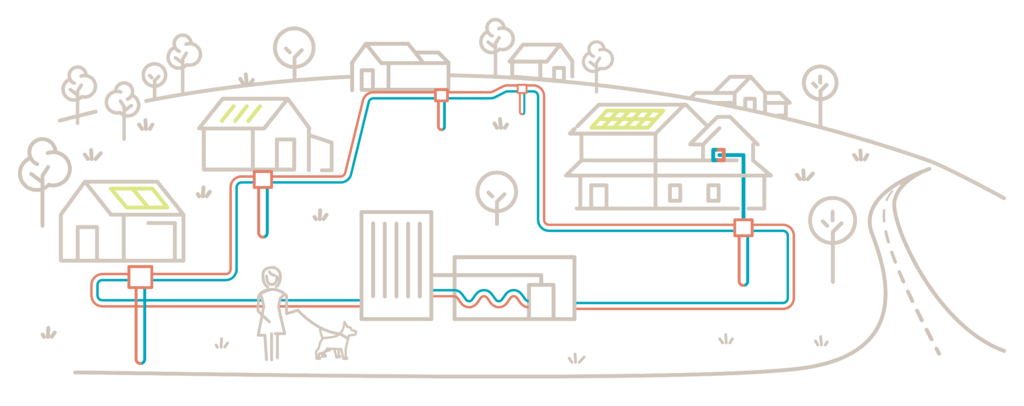
A diagram of the GeoGrid™. Image credit: Ecosmart Solution.
Constructing A Zero-Energy-Capable Community
Whisper Valley’s story begins in 2006, when land developer Taurus Investment Holdings acquired 2,065 acres of land in East Austin, Texas. Today, it’s a growing community of more than 800 single-family, duplex, and triplex homes. Four phases of construction are complete, and the development is on its way to an expected total of 7,500 housing units at full buildout. All homes are “zero-energy-capable,” equipped with high-efficiency appliances, solar panels, and optional home batteries in addition to geothermal heating and cooling.
Ecosmart Solution is a subsidiary of Taurus, and the two companies partner during each new phase of development. When Taurus plans a new phase of 200-400 homes, Ecosmart’s team gets to work on the geothermal infrastructure: engineering, laying out pipe plans, assessing capital needs, and securing construction capital. By requiring a minimum of 200 lots per phase to move forward, Ecosmart captures economies of scale and reduces the cost of conventional geothermal heating and cooling by 50% per home.
GeoGrid™ construction is financed with industry-standard infrastructure debt. After the network is operational, the company transitions to long-term, permanent financing. Ecosmart works with specialized green infrastructure lenders like Locus Impact, along with institutional investors “backed by insurance companies who appreciate the long-term, annuity-like revenue,” Gray says.
Every phase of construction also involves coordination with Bluebonnet Electric Cooperative, the local utility. Because the GeoGrid™ does not generate electricity, there’s no need for a formal interconnection agreement between Ecosmart and Bluebonnet; still, they work closely together, Gray explains. “Our system is a real benefit to Bluebonnet,” he says. “The fact that we’re reducing the demand of every home allows them to reduce the size of their infrastructure.”
Construction includes drilling a geothermal borehole for each home, located underneath its backyard. Inside the borehole, Ecosmart installs a U-loop of pipe, which provides each home with baseload heating and cooling capacity. That loop connects to the larger GeoGrid™, which allows for additional thermal energy sharing between buildings, improving efficiency and resiliency for everyone. At the heart of the entire system is the Whisper Valley Energy Center, the pump house where Ecosmart Solution monitors performance.
Once each lot’s U-loop and GeoGrid™ connection is in place, homebuilding firms pour their foundations, construct their homes, and tap into the GeoGrid™ via each home’s Geothermal Connection Box—and the home is ready for sale.
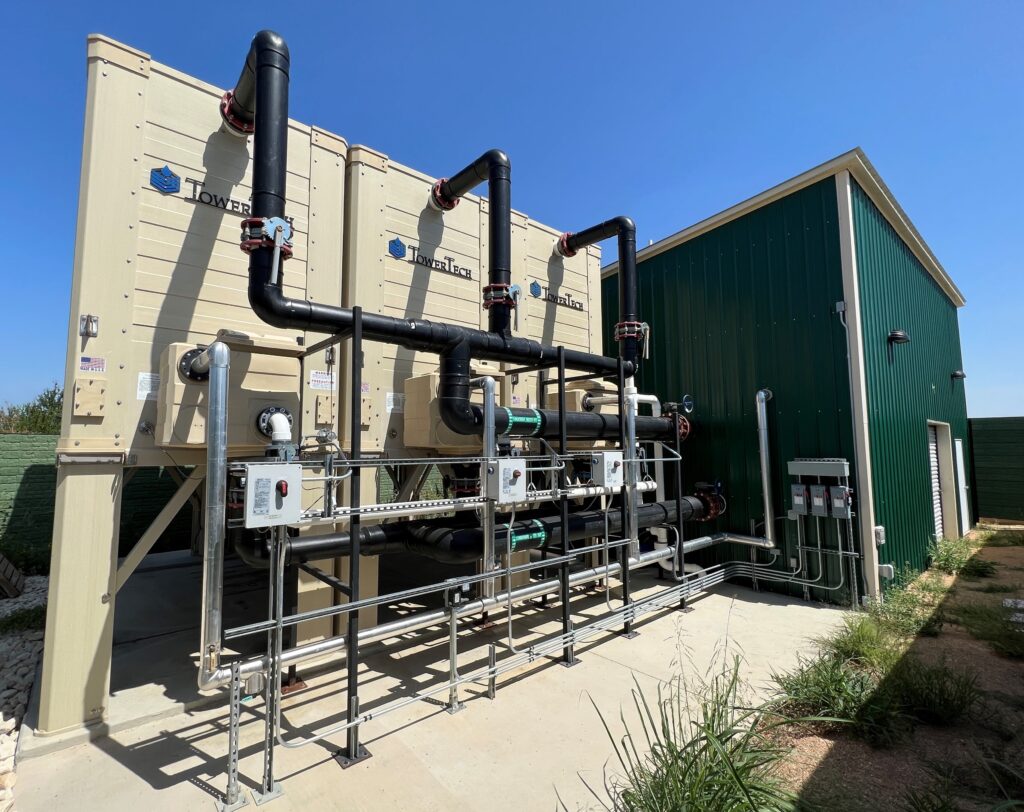
The Whisper Valley Energy Center. Image credit: Ecosmart Solution.
The Homeowner Moves In
When a buyer purchases their Whisper Valley home, the purchase price includes a one-time GeoGrid™ connection fee, which transfers to Ecosmart upon closing. The new homeowner is now the owner of their geothermal heat pump equipment, their Geothermal Connection Box, and the vertical U-loop on their property. Whisper Valley maintains an easement on each lot for the connecting GeoGrid™ infrastructure, and maintains ownership of and responsibility for that infrastructure from each Connection Box back to the Energy Center.
Each month, homeowners pay Ecosmart Solution a fixed monthly fee for access to the GeoGrid™. The fee varies by lot size—it is typically around $60—and covers ongoing operational costs, warranty, service, and system maintenance. The fee is calculated based on detailed financial modeling that factors in local energy rates, heating and cooling loads, construction costs, and projected lifespan and performance of the system, according to Gray. The result is a predictable monthly cooling and heating cost for homeowners, and a stable revenue stream that can be indexed to inflation for the developer: “We want to align the benefits for everyone,” says Gray.
Affordability is always a key interest. “As long as we are facing the pressure of higher energy costs, people will look for ways to control their living expenses,” Gray explains. “We want to help them control their energy bills and make them predictable, and hedge against the unknown future of energy rates.”
Ecosmart works proactively to help homeowners and potential buyers understand the value of the system. “We want to ensure residents understand the value proposition of this system,” says Gray. “We do a ton of education, engage with neighborhood associations, and participate in HOA meetings. We want to empower homeowners and simplify the decision-making process for adoption.” For residents who want to go deeper, a “discovery center” at Whisper Valley provides a touchscreen interface and diagrams explaining how the GeoGrid™ works, demystifying the system and highlighting its benefits.
“Our work goes beyond individual projects. It’s about educating the market and demonstrating how practical, energy-efficient solutions can contribute to a more resilient, sustainable built environment.”
Chris Gray, Chief Executive Officer, Ecosmart Solution
Financing Into the Future
Whisper Valley is not the only community served by Ecosmart Solution; they also operate a GeoGrid™ in a multifamily development in Florida, and are involved in future developments elsewhere in Texas.
Private developers offer a unique model for TENs like the GeoGrid™, Gray explains: “Private developers can offer flexible business models that meet everybody’s needs—we can quickly deploy and access capital, deploy different capital sources for construction as well as equity, and bring in new investors to scale as we need.”
Still, there are opportunities to make the construction of geothermal networks even more cost-effective. While homes in Whisper Valley are sold at market rate, access to low-cost capital could unlock TEN development for below-market-rate homes, leading to a “very significant reduction” in home cost, Gray says. Even better, he adds, would be if those loans could convert into permanent financing once the project is complete. Combining low-cost construction loans with affordable long-term debt would make a meaningful difference in making affordable housing with TENs more feasible.
In June 2025, new statewide financing opportunities arrived for geothermal networks when the Texas legislature passed House Bill 4370, which amended the Texas Local Government Code to allow cities, water districts, and special-purpose districts to finance geothermal networks through public bonds, providing a new pathway for local governments to invest in TENs.
Through the variety of available financing mechanisms, Ecosmart Solution’s goal is to scale these systems in a cost-effective way. Scaling geothermal network systems requires educating not just homeowners and buyers, but also market actors, including land developers and builders.
“Our work goes beyond individual projects,” Gray emphasizes. “It’s about educating the market and demonstrating how practical, energy-efficient solutions can contribute to a more resilient, sustainable built environment. We need a greater awareness of geothermal and its benefits. We need more home builders willing to change their practices to adopt geothermal, and more developers taking on this type of infrastructure across the country. To scale, it takes people willing to do something different.”
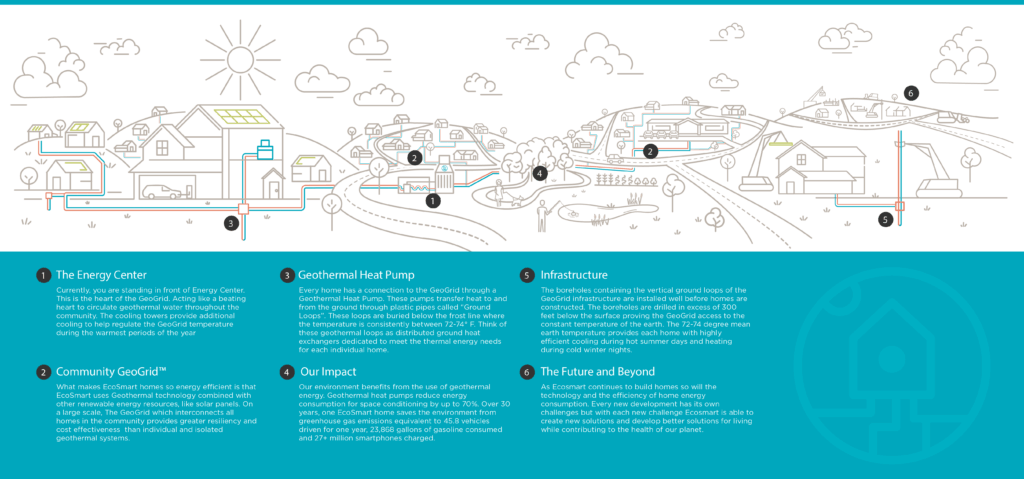
Communicating the benefits of the GeoGrid™. Image credit: Ecosmart Solution.
Thank you to Chris Gray for your contributions to this case study.