There are two key races in the energy transition: the renewables race to generate electricity, and the electrification race to supply final energy demand for heat, mobility, and other services. Alongside the momentum of the digital revolution, new technologies (electrotech) are accelerating the energy transition and building electrification.

On our latest BDC Presents – The [Building] Electrification Imperative webinar, featuring Ember’s Daan Walter and Building Decarbonization Coalition’s (BDC) Panama Bartholomy, we discussed why electrification is the more consequential race today.

Transforming Buildings Through Electrification

Check out the BDC Presents: The [Building] Electrification Imperative webinar recording and notes to learn more about how electrifying buildings can make energy more affordable, accelerate the clean energy transition, and unlock the largest economic opportunity of our time. Explore the fireside chat at the end of the presentation to dive deeper into the important role that electrification plays in making the transition and energy bills affordable.


The Electrification Imperative

Daan Walter, Ember Principal, shared great insights during the webinar about The electrification imperative report. Ember’s report examines market trends, geopolitical dynamics, policy gaps while positioning electrification as a central driver of decarbonization, energy security, and economic value.

Key Insights:

  • “This is the decisive decade that we’re in. …this is going to be the decade when the electrotech wave will start to come across the U.S., and so now we need to decide whether we are going to surf that wave, or we’re going to be dragged under by it.” – Daan Walter
  • “Electrotech is this exciting new rise of these new technologies on the supply side, demand side, and the connections in between…We are coming out of this century of evolution on electric technology, and we’re now going into this decade of revolution.” – Daan Walter
  • “Today, 75% of the energy system can now be electrified, and not just technically electrified, it can be competitively electrified. ” – Daan Walter
  • “Electrification can not only save much more money, by our estimations, roughly 3-5% of disposable income that we can actually free up with electrification. But you also just get new and better technology…” – Daan Walter
  • “The U.S. is the number one market for heat pumps in the world. For the past three years, heat pumps have been outselling furnaces, with sales of 4.2 million heat pumps in 2024.” – Panama Bartholomy

Report Takeaways:

  • Electrification is missing in today’s energy debate: Public debate, government targets, and corporate plans are focused on renewables. Today’s energy debate is largely missing electrification. Electrification is too often an afterthought.
  • Electrification hits home for consumers: While renewables can make electricity more affordable, electrification upgrades the everyday technologies households rely on—cars, heating, and control systems—delivering better value and greater savings.
  • Electrification is a huge economic opportunity: Global revenues of key electrification technologies such as electric vehicles (EVs) and heat pumps are already three times those of solar panels and wind turbines, and are projected by the IEA to be eight times larger by 2035.

Resources

Stay connected with us for upcoming events by signing up for the Building Decarbonization Coalition newsletter or visiting our website.

Written by BDC and Sunstone Strategies

Congratulations, folks, we’ve just completed another trip around the sun! Glad you’re still on board. Next stop: 2026. 

Before we step into the new year, 2025 deserves reflection and celebration. This has been a defining year for the building decarbonization movement that can be punctuated by a keyword: affordability. 

Across the nation, households are experiencing rising costs on all fronts: at the grocery store, in their monthly rent, and on their utility bills. Rollbacks of critical federal funding for climate and energy assistance are tightening the squeeze on those already struggling to make ends meet. Voter frustration culminated in what’s been described as November’s “energy affordability” election, in which Democratic candidates swept races with a focus on lowering utility bills. 

As AI, data centers, and demands for affordability clash to rewire U.S. politics, clean energy and energy-efficient homes and equipment are emerging as clear political winners. That’s because renewable electricity is the cheapest form of energy on the planet, and electric technologies are the most modern and energy-efficient technologies on the market. While we have plenty of work in front of us, we know that affordable, clean electricity—paired with modern and energy-efficient homes, buildings, and electric technologies—is the long-term affordability solution we need. Translating this formula into a reality for everyone will continue to drive our work into the new year and beyond.

As we look toward 2026, nothing is more motivating than progress. And we’ve made plenty of progress this year. So let’s take a look at the greatest hits of 2025, reflect on our wins, and prepare the path for a more affordable 2026.

Key Takeaways

  1. The leading driver of inflation? It’s not eggs.
  2. Gas infrastructure is an expensive problem. Electrification is the solution.
  3. The grid is cleaner than ever. Let’s keep it that way.
  4. Heat pumps are trending and the U.S. is leading.
  5. Specialized electric rates for heat pumps are saving households hundreds of dollars.
  6. Building decarbonization isn’t just for “blue states”— it’s taking off nationwide.
  7. Customers footing the bill for gas expansion and lobbying? Not anymore, say states.
  8. Removing gas line subsidies delivers affordability and more all-electric buildings.
  9. Electric Buildings go BIG.
  10. Thermal Energy Networks are hotter (and cooler) than ever.
  11. Electric building code innovation drives momentum.
  12. Clean technology keeps getting more accessible and more affordable.
  13. The future of kitchen design is here and powered by induction.
  14. Workers are the heroes we need to accelerate clean homes and buildings at scale.
  15. It’s easier than ever to find a qualified contractor to upgrade your home.
  16. The next generation is learning how to make their neighborhoods clean and green.

1. The leading driver of inflation? It’s not eggs.

If electricity is the new price of eggs, then gas is bird flu. 

In the past year, gas bills have risen nearly 12%—more than twice as fast as electric bills, outpacing the rate of overall inflation by almost 400%. In fact, between September 2024-2025, gas bills increased more than the cost of groceries, rent, clothing, and medicine combined.

CPI 12 Month average, Sep 2025


2. Gas infrastructure is an expensive problem. Electrification is the solution.

Even if households turn down their thermostats to save money this winter, their gas bills may continue to grow. That’s because most of your gas bill pays for what a utility builds–not what you use to heat your home.

Today, gas utilities are installing or replacing expensive gas pipelines below our feet, even as demand stagnates and declines. The charts below show how utilities have been ramping up new infrastructure (“gas plant”) even while customer demand and customer growth stagnate.  

Total Gas Plant In Service

Gas Customers And Sales Volume

The cost of these new pipelines is passed on to households in the form of higher energy bills that will be paid for decades to come. In fact, on average, 66% of our gas utility bills go toward infrastructure projects like pipeline replacements. What this looks like is an annual bill of $21 billion that households are collectively paying for gas infrastructure, and by 2050, we’ll have spent $1.4 trillion on a system that is declining. 

Why spend money on two energy systems when we only need one? Having separate gas and electric infrastructure might have made sense in 1905, but not in 2025. Today, electric appliances outperform and outsell gas appliances in almost every category. 

The bottom line is that we don’t need polluting, expensive gas. We should only pay for the clean energy system that we need: a resilient electric grid paired with thermal energy networks.


3. The grid is cleaner than ever. Let’s keep it that way.

To lower costs for households, we need to focus on the supply side of electrification (the grid) as well as the demand side (how our buildings use energy). To power our grid with the most affordable type of energy out there, our electricity must be generated by abundant and clean renewable energy sources like wind and solar. 

In 2025, we saw the supply side invest in new clean energy projects that will affordably power the grid. Nearly 93% of new capacity came from renewables such as solar, battery storage, and wind. This incredible boom contrasts greatly with the turn of the century, when clean technologies made up less than 5% of new capacity. It’ll take all of us to keep this trend moving in the right direction, especially as fossil fuel interests attempt to turn the clock back to coal and methane gas plants. 
Grid Is Cleaner


4. Heat pumps are trending and the U.S. is leading.

Back on the demand side, we are excited to see that after years of growing sales, the U.S. passed China to become the number one market for heat pumps in the world this year. And it’s no wonder that households love heat pumps or why 90% of heat pump owners would recommend them to a friend. Heat pumps are three to four times more efficient than gas furnaces, which reduces energy use and lowers monthly utility bills. 

The rise of the heat pump market shows how households are choosing highly efficient, affordable heating and cooling options. This year, heat pumps once again outsold gas furnaces, a trend that’s occurred three straight years in a row. Encouragingly, heat pump sales are also closing the gap on air conditioning systems.

Ahri Cumulative Shipments


5. Specialized electric rates for heat pumps are saving households hundreds of dollars.

According to The New York Times, nearly 80% of American households can save on their energy bills right now by upgrading to heat pumps. But that number, and the amount of savings, can be magnified thanks to specialized electric rates. 

Households with heat pumps benefit their neighbors by helping to subsidize more costs related to grid infrastructure. Creating specialized electric rates takes this into account and lowers the costs of operating a heat pump. A 2025 study found that heat pump customers switching to electrified heating rates could lower their energy bill by $240 annually on average

Today, more than 17 utilities have heat pump-specific rates and another 76 have broader electrified heating rates that are saving heat pump users hundreds of dollars. Massachusetts utilities are the most recent to launch a heat pump rate, which is projected to save heat pump owners an average of $540 this winter.


6. Building decarbonization isn’t just for “blue states”— it’s taking off nationwide.

From Texas and New Mexico, to New York and Illinois, 130 bills were introduced advancing building decarbonization in 2025, with 41 passing. See highlights of some legislative wins this year: 

  • IL SB25: Illinois lawmakers recently passed The Clean and Reliable Grid Act during the veto session, which will allow the state’s climate bank to finance $20 million for thermal energy network projects. The legislation also includes key provisions that will advance clean energy in the state, including energy storage procurement targets, energy storage rebates, virtual power plants, interconnection reforms, load energization timelines, and thermal energy networks. 
  • NY A88888/S8417: A grassroots-led effort by the Renewable Heat Now campaign and allies like BDC resulted in the passage of legislation, awaiting signature by the Governor, that ended the 100-foot rule—an unfair, outdated rule that allows utilities to profit by charging existing customers for the cost of extending gas pipelines to new customers, which costs New York ratepayers $581 million on their energy bills each year. 
  • CA AB 39: Requires cities and counties to develop local building electrification plans, expanding access to clean energy technologies like heat pumps and EV charging.
  • MD HB 1035: In one of two major energy bills passed this year, lawmakers passed legislation that would rein in utility bills by limiting spending on the gas system previously authorized under a 2013 law. The legislation would also increase grid resilience through battery storage and reduce data center cost shifting. 
  • TX HB 4370: Amends the Texas Local Government Code to designate geothermal infrastructure, including neighborhood-scale thermal energy networks, as Public Improvement Projects, which allows utility and non-utility entities (e.g. municipalities, water districts, and others) to own and operate geothermal infrastructure and to finance them through public bonds.
  • NM HB 2: This budget bill establishes funding for key climate initiatives such as geothermal project development ($10 million) and a Community Benefit Fund ($209 million) to finance a wide array of climate projects, including ones that support fossil fuel transition.

In addition, three states passed legislation that will address the Future of Gas, six bills were passed that proposed innovative and equitable solutions for modernizing homes with efficient electric technologies, and 17 bills were proposed to support cost-effective, energy-efficient upgrades for entire neighborhoods at once.

Decarb Topic Areas


7. Customers footing the bill for gas expansion and lobbying? Not anymore, say states.

States are leading the way toward the clean, affordable future we deserve by putting the brakes on unnecessary gas spending. 

This year, legislators and regulators in Oregon, New York, and California ordered utilities to stop charging customers for their lobbying and marketing campaigns. 

On top of that, twelve states and D.C. are currently working to end line extension allowances, an outdated, unfair rule that allows gas corporations to charge existing customers for the cost to extend gas pipelines to new customers. Ending this practice across the U.S. could save existing customers up to $7 billion and slow the unnecessary expansion of the gas system.

Line Extension Allowance Hex Map


8. Removing gas line subsidies delivers affordability and more all-electric buildings.

Removing these unfair gas subsidies has already kick-started a surge in constructing all-electric homes, which are cheaper and faster to build, helping deliver on affordability.

In California, in the two years after the state ended gas line extension allowances, the new construction market shifted significantly toward all-electric construction in all three major investor-owned utilities in California.

Percentage of Applications for All-Electric New Construction as of Q1 2025


Residential 

Non-Residential

Pacific Gas & Electric Company

73%

91%

San Diego Gas & Electric Company

65%

75%

South California Edison Company

49%

57%

For reference, just 8% of homes were all-electric in California, according to 2020 data. The increasing popularity of all-electric buildings in the Golden State shows that developers understand that building all-electric is cost effective and efficient and that consumers want efficient, affordable electric appliances. We expect this trend to transfer to the five other states that have just eliminated line extension allowances

Ending these costly mandates is also encouraging the construction of affordable, healthier, and more resilient all-electric homes that families will enjoy for decades to come.

Cpuc Line Extension Data All Electric Rates


9. Electric Buildings go BIG.

The workplace of the future is all-electric. JP Morgan’s new headquarters, launched in October of this year, is the largest all-electric tower in New York. It comes just one year after New York’s first all-electric residential skyscraper launched in Brooklyn. It’s not just new construction. Investments to decarbonize large existing buildings are picking up as well. New funding in New York to advance low-carbon heating system retrofits and the introduction of AtmosZero’s drop-in heat pump boiler is helping to affordably expand decarbonization efforts to larger buildings.  

When the All-Electric Building Act goes into effect, New York’s new buildings under seven stories will be constructed with efficient and affordable all-electric appliances. While the law is currently facing an implementation delay due to a legal challenge, the NYS Building Code Council approved a code this summer that includes all-electric new construction, in particular highlighting the cost savings for consumers and the cost-effectiveness of the policy. Advocates are continuing to highlight the opportunity to save consumers money while ensuring healthier, safer, cleaner new development.


10. Thermal Energy Networks are hotter (and cooler) than ever.

We’ve said it before and we’ll say it again: Framingham is the Disney World of building decarbonization. 

This Boston suburb is home to the nation’s first utility-led thermal energy network (TEN), which celebrated its first anniversary of operation this summer. TENs are our favorite way to electrify on a neighborhood scale because they can lower energy bills, improve air quality, ease strain on the grid, slash climate pollution, and create good-paying jobs. (Read more about TENs here.)  

One in four states has now passed legislation related to thermal energy networks—whether it advances studies of TENs, unlocks new avenues for financing, or all-out requires regulated utilities to pilot TENs. In addition, TENs remain eligible for federal tax credits, despite rollbacks on other clean energy technologies. 

And twenty-six utility-led TENs pilots are currently advancing through eight states: Colorado, Maryland, Massachusetts, Minnesota, New Jersey, New York, Washington, and Illinois. These pilots join the many non-utility-led TENs already under construction or operational in cities and campuses nationwide

As TENs pilots like Framingham succeed in winning over customers, communities, lawmakers, and executives, we’ll see a paradigm shift in which gas utilities transition from distributing gas to distributing heat, including heat from geothermal sources.
Tens Diagram Full Square Labeled Title


11. Electric building code innovation drives momentum.

Here’s a trivia question: what’s the best time to upgrade to a highly efficient heat pump? 

If you answered “when your AC breaks down,” you got it right! 

Alongside states, cities are also playing a crucial role in advancing building decarbonization through innovative means. A growing number of local jurisdictions in California are encouraging the adoption of highly efficient heat pumps when household air conditioning systems fail. The strategy maximizes an opportunity to leverage the timing when necessary wiring, electrical capacity, and space are already in place to seamlessly install a heat pump without extra costs for households.

As of December 8, 13 cities in the Golden State have passed some version of “A/C to Heat Pump” building codes, demonstrating how cities are stepping up with innovative strategies to deliver efficient, electric appliances to households. According to BDC’s Why Cooling is Key report, if every California household installed a heat pump when their AC failed, and used it to replace a gas furnace, 51% of home heating and cooling in California could be electrified by 2030. This not only helps provide efficient and affordable cooling for households, it can be life-saving during extreme heat.Ca Ac2hp 2025


12. Clean technology keeps getting more accessible and more affordable.

Small living space? Low-voltage outlet? Large, multifamily apartment building?

No matter your living space, new models of efficient, electric appliances are making it easier than ever for households to decarbonize. GE recently introduced 120V and 240V heat pump water heaters that can be installed with any type of wall outlet. Summit Appliance just came out with a two-zone, 115V induction cooktop for small kitchen spaces. In Massachusetts, cities are piloting window heat pumps for affordable retrofits in hundreds of multifamily apartment building units. In California, the state is going all in on affordable, efficient, and renter-friendly appliances, allocating $115 million for lower-income residents to install window-unit heat pumps and plug-and-play 120V induction stoves.  Meanwhile, the New York City Housing Authority is replacing gas stoves in public housing with 10,000 energy-efficient, 120V battery-equipped induction stoves from Copper.

With newer models of clean technologies coming to market, costs will come down. Already, Jetson, a Vancouver-based heat pump startup, is using a new direct-to-consumer approach that cuts heat pump installation costs in half.

Chef Kimberley Ca Hh

Chef Kimberley Ayala and Copper Co-Founder and CMO Weldon Kennedy demonstrate the power of Copper’s 120V stove at the 2025 Electric Happy Hour in Sacramento, CA.

Induction 2

An affordable and portable induction hob chars tortillas.


13. The future of kitchen design is here and powered by induction.

Induction cooking is taking over one dish at a time. Already the favorite of notable chefs such as Eric Ripert, Alton Brown, and Jon Kung, induction stoves are now dominating the future of home cooking and design. Nearly two out of every three kitchen designers attest that within the next three years, induction will be the most popular way to cook, according to the National Kitchen & Bath Association’s 2025 Kitchen Trends Report. And House Digest is already forecasting that induction will be 2026’s Big Kitchen Trend.

The numbers back these projections, too. The U.S. is the fastest-growing market for induction stoves, and growth is expected to increase at an average of nearly 8% annually over the decade. The offerings continue to expand with innovation, including Novy’s “invisible” counter hob, Samsung’s minimalist induction stove with a concealed exhaust duct, and GE’s induction range with a dynamic and seamless “Griddle Zone.”


14. Workers are the heroes we need to accelerate clean homes and buildings at scale.

No heat pump or thermal energy network ever installed itself. The success of the building decarbonization movement depends on the HVACR and plumbing workforce. 

Thankfully, the U.S. clean energy workforce is growing. Student enrollment in two-year HVACR associate degree programs jumped nearly 30%, with about 25,000 enrolled students, compared to last year. Plumbing enrollment at two-year colleges rose over 20%

Our future HVAC technicians, plumbers, and pipefitters will be essential to installing and maintaining heat pumps for homes and businesses, and realizing the clean energy transition. 

Contractor 3


15. It’s easier than ever to find a qualified contractor to upgrade your home.

With more and more contractors entering the field, there’s never been a better time to upgrade your home. BDC’s The Switch Is On contractor finder has over two thousand qualified contractors available in California, New York, and Washington. You can conveniently connect with a professional to get expert, personalized advice tailored to your project. And with the handy incentive finder, you’ll be able to explore rebates in your zip code.


Contractor 1


16. The next generation is learning how to make their neighborhoods clean and green.

The building decarbonization movement is built on progress. And we’ll need future generations of leaders to carry the work forward.

That’s why BDC partnered with four building trades and manufacturing unions to produce a children’s book about the workers who transform our neighborhoods with clean energy infrastructure. We hope that focusing on the generations to come will build a broader understanding of the movement and the workers who make the clean green transition possible.

CleangreenneighborhoodAs we close out 2025, this project reminds us why we do this work: we’re building a world where the next generation can breathe easier, dream bigger, and inherit thriving, resilient communities powered by affordable clean energy. With that spirit guiding us, we look to 2026 with renewed purpose and a belief that the story we’re writing together is only just beginning.


Welcome to The Clean Green Neighborhood!

By Tryn Brown, Associate Manager of Communications, and Javonne Lane, Senior Content Manager  

Imagine living in a neighborhood where the air is healthy, the buildings are safe and efficient, and the energy is clean. That’s what our new children’s book, The Clean Green Neighborhood, is all about: shifting to clean energy to transform the places where we learn, work, and play into healthier, more resilient spaces that we all deserve to live in.

These neighborhoods run on clean energy infrastructure, like thermal energy networks and an electric grid that is powered by renewable energy sources like the sun, wind, water, and earth. They are specifically designed to be more comfortable, efficient, and affordable for residents, and it’s clear that our communities are ready for this more resilient way of living.

Circle around, it’s story time

Explore the pages of The Clean Green Neighborhood with the author, Kristin George Bagdanov, Building Decarbonization Coalition’s Senior Policy Research Manager. Through vivid storytelling and illustrations by climate artist Nicole Kelner, the book paints the vision of what is possible when communities embrace neighborhood-scale decarbonization and building electrification. As you watch our video or read the book, imagine how your community could transform and what role you can play in that process.

Help us get the word out about a cleaner, greener future

Six people at a ribbon cutting for a new clean green neighborhood You play an important role in bringing the building decarbonization movement to your community. We hope you’ll help us share this inspiring story in classrooms, libraries, offices, and homes across the country.

The book is an inspiring tool for education, community engagement, and sparking meaningful conversations about our clean energy future. It also makes a wonderful holiday gift for adults and children alike. 

Order Your Copy

Why should we transition our neighborhoods to clean energy?

Many of our homes, schools, and businesses still rely on fossil fuels to heat our buildings, water, and food. When these fuels are burned to create heat, they pollute the air in our homes and neighborhoods by releasing powerful emissions including carbon monoxide, formaldehyde, and nitrous oxides that are unhealthy for our communities and our planet.

Building decarbonization is a process that removes fossil fuels from our communities and buildings to help reduce greenhouse gas emissions that warm the climate and amplify extreme heat and weather events like wildfires. It also makes inside air cleaner and safer to breathe and increases energy efficiency in buildings to help advance energy affordability.

Pathways to cleaner, greener communities

While it’s great when individual people or buildings switch to clean energy, a more coordinated approach called neighborhood-scale building decarbonization makes it easier and more efficient, fun, and cost-effective for neighborhoods to transition. A neighborhood-scale project is perfect for labor unions, who have a history of doing big infrastructure projects and who are highly skilled due to their intensive apprenticeships and depth of experience. In our story, the union workers who build the clean green neighborhood are also the ones who live in it, which means they get to enjoy the benefits of their hard work.

We recommend two pathways for transforming an entire neighborhood into a clean, green neighborhood: the thermal energy network and the electric pathway.

Thermal energy networks
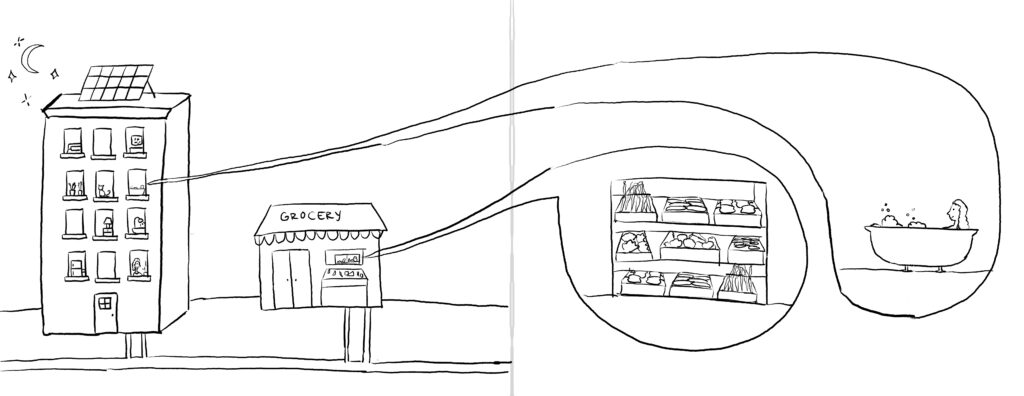
The book depicts the construction of thermal energy networks, or systems that share energy from the natural heat of the earth and excess heat produced by neighboring buildings instead of relying on non-renewable, polluting fuels. These networks look similar to the network of gas pipes that run beneath most of our neighborhoods, which is why many of the workers who currently use their special skills to build and maintain the gas system can use these same skills to build and maintain thermal energy networks.

All-electric neighborhoods
Another option is to electrify an entire block instead of installing a thermal energy network. For this pathway, workers simply swap out all of the gas appliances in each building and replace them with modern, efficient electric appliances like heat pumps and induction stoves. They can also add infrastructure for electric vehicles and upgrade doors, windows, and insulation through a process called weatherization, which makes buildings more energy efficient.

Sharing power for the greater good

Whether by way of a thermal energy network or an all-electric neighborhood, sharing energy back and forth can help us be good stewards of our resources so that future generations of people, plants, and animals can enjoy the clean, green neighborhood that builds a healthier planet. When we work to embrace shareable, renewable energy, we can create stronger, more sustainable communities today and into the future.

FOR IMMEDIATE RELEASE

November 13, 2025
Media Contact:
Robin Tung
Director of Public Relations
robin@buildingdecarb.org

Children’s Book Celebrates Union Workers and Communities Building Clean, Green Neighborhoods
The Clean Green Neighborhood launches November 13 in English and Spanish.

Sacramento, CA — Today, the Building Decarbonization Coalition (BDC) announced the release of The Clean Green Neighborhood, a bilingual English-Spanish children’s book that celebrates the union workers and communities building and thriving in neighborhoods powered by renewable energy. Written by Kristin George Bagdanov, illustrated by Nicole Kelner, and translated by José Torres, the book is now available for purchase at buildingdecarb.org/clean-green-neighborhood.

The book was produced by the BDC with the sponsorship and creative guidance of four labor unions: International Union of Operating Engineers Local 12, International Brotherhood of Electrical Workers Local 11, International Association of Sheet Metal, Air, Rail, and Transportation Workers Locals 104 and 105, and United Auto Workers Region 6. Representatives from each of these locals served on a Creative Advisory Board to guide written and visual content and share ideas for highlighting the essential role of labor unions in a clean energy transition.

The Clean Green Neighborhood tells the uplifting story of how union workers transform their neighborhood to become sustainable and resilient through shared renewable energy. Educators, parents, and community members can use it as a tool to spark conversations about how communities, clean energy technology, and teamwork come together to shape the world we live in for the better.

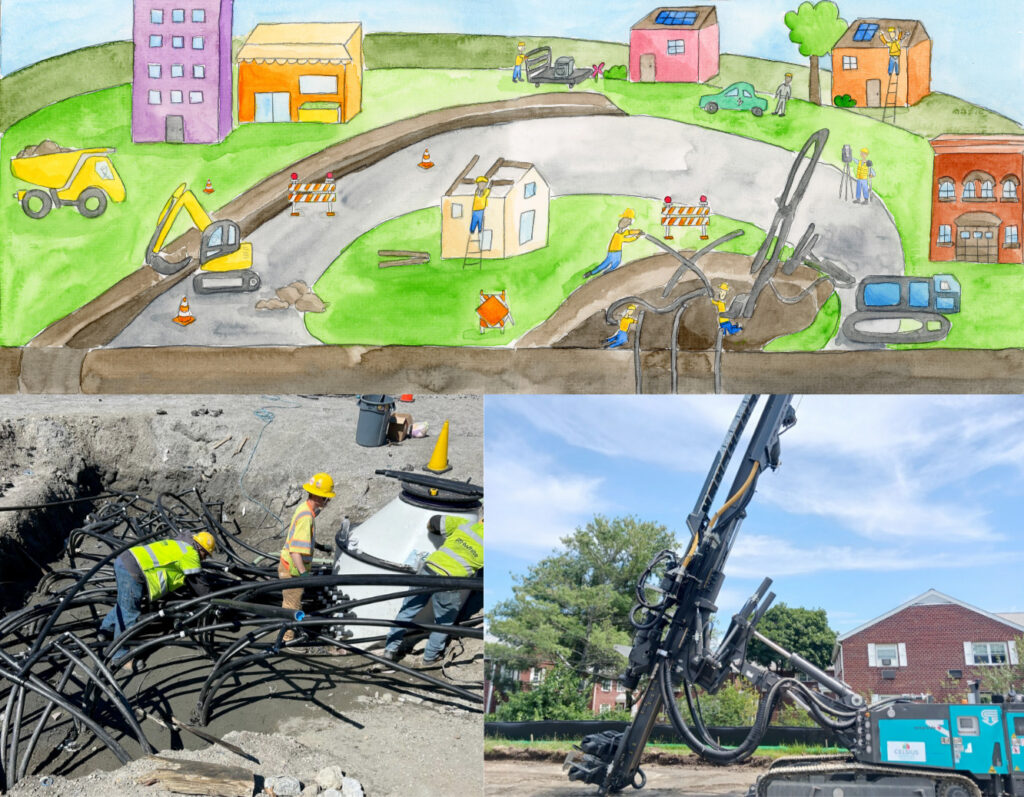
Whimsical watercolor illustrations transform construction sites, electric appliances like heat pumps and induction stoves, and renewable energy resources into a people-centric vision of a clean-energy community. A thermal energy network becomes a “sharing circle” that heats and cools homes, while workers ranging from operating engineers to electricians celebrate the future-proof neighborhood they have built for their families and futures. The book concludes with a visual glossary explaining what makes a neighborhood “clean and green,” along with a chart highlighting the roles of the unions that make the clean energy transition possible.

The Clean Green Neighborhood celebrates the people at the heart of the neighborhood-scale clean energy transition,” said Panama Bartholomy, Executive Director of the BDC. “This book beautifully illustrates what we believe: it’s possible to build neighborhoods that can improve people’s health, cut climate and air pollution, prioritize high-road jobs, and ensure that our communities are more resilient to the impacts of climate change.”

“For generations, we’ve been training the workforce to do this work,” said EJ Cire, Political and Public Relations Representative for Sheet Metal Workers’s Local Union 104. “It is a privilege to be part of the youth’s education around the green economy.”

“Local 12 is excited to participate in this educational opportunity,” said Matthew Gaines, Political Director for International Union of Operating Engineers, Local Union 12.The Clean Green Neighborhood not only shares with our children a snippet of how some of our infrastructure works, but also showcases work that is done by everyday people, some of whom may be in their own family.”

“Our members live and work in the communities they help power and build,” said Robert Corona, Business Manager of the International Brotherhood of Electrical Workers (IBEW) Local 11. “We’re so proud to show the next generation that building a cleaner community means good jobs, safe neighborhoods, and a future where everyone has the opportunity to thrive.”

Mike Miller, Director of UAW Region 6 said: “UAW Region 6 is proud to see this beautiful book on neighborhood decarbonization in print. It paints a wonderful picture of how we can grow good union jobs and safe, clean neighborhoods through clean energy development. We have no doubt this book will inspire our children, and hopefully their parents too.”

Order The Clean Green Neighborhood today at buildingdecarb.org/clean-green-neighborhood and help inspire the next generation of builders, community members, and changemakers.

###

ABOUT THE BUILDING DECARBONIZATION COALITION

The Building Decarbonization Coalition (BDC) aligns critical stakeholders on a path to transform the nation’s buildings through clean energy, using policy, research, market development, and public engagement. The BDC and its members are charting the course to eliminate fossil fuels in buildings to improve people’s health, cut climate and air pollution, prioritize high-road jobs, and ensure that our communities are more resilient to the impacts of climate change. Learn more at www.buildingdecarb.org.

Media Contact: 
John Lindsay
john@moxiestrategies.com
Phone: 518-368-9086

FOR IMMEDIATE RELEASE
November 13, 2025

STATEMENT IN RESPONSE TO DELAYED IMPLEMENTATION OF THE ALL-ELECTRIC BUILDINGS ACT

ALBANY, N.Y. — The Building Decarbonization Coalition released the following statement in response to New York State’s delay in implementing the All-Electric Buildings Act:

“Since 2023, the State Building Code Council has worked tirelessly to lay the groundwork for implementing the landmark law requiring new construction of small buildings to be all-electric starting in 2026. Through extensive stakeholder engagement and technical review, the Council developed and unanimously approved an updated building code in July – a major step toward cleaner, healthier, and more affordable pollution-free buildings, in alignment with New York’s clean energy goals. We are deeply discouraged by this unnecessary delay, and look forward to this appeal being resolved in a timely manner so this cost-saving, common-sense affordability and clean energy measure can move forward. Every day of inaction slows progress toward safer and more affordable new homes and buildings.”

###

ABOUT THE BUILDING DECARBONIZATION COALITION
The Building Decarbonization Coalition (BDC) aligns critical stakeholders on a path to transform the nation’s buildings through clean energy, using policy, research, market development, and public engagement. The BDC and its members are charting the course to eliminate fossil fuels in buildings to improve people’s health, cut climate and air pollution, prioritize high-road jobs, and ensure that our communities are more resilient to the impacts of climate change. Learn more at www.buildingdecarb.org

Smart Panels Can Speed the Completion of Electrification Projects, Delivering Both HVAC Installers and Homeowners Economic and Other Benefits

While many homeowners think they need to get a service upgrade to add a heat pump, EV charger, or other technologies that draw significant power, a smart electric panel can effectively manage all this and more. Since its launch in 2015, SPAN has been a leader in the development of smart panels.

BDC sat down with Karen Gough, SPAN’s Vice President of Sales, to learn more about how a smart panel might be able to help people qualify for IRA electrification incentives before they expire at the end of the year, and the other benefits smart panels can deliver to all-electric homes.

BDC Question: Thanks for chatting with us, Karen. What are some ways that smart panels help installers ensure their customers do not miss out on federal electrification incentives before they end on December 31st?

Karen Gough of SPAN Headshot

Karen Gough, SPAN VP of Sales: It’s true that due to the rollback of the Inflation Reduction Act, many incentives for home electrification will expire at the end of the year. And with utility service upgrades in some areas taking as long as an entire year, some people might be afraid of missing out on the incentives as they wait for these upgrades to be completed.

But contractors who install certain smart panels can eliminate these utility upgrade wait times—and in doing so, complete their heat pump and other electrification upgrade projects in time to qualify for these federal incentives.

Smart panels with circuit-level controls can manage load capacity behind the meter, avoiding the need for a utility service upgrade. Not only can this help some homeowners take advantage of federal incentives before they end, but it can also deliver other benefits even after these incentives expire.

For example, by speeding up electrification project timelines, these types of smart panels can reduce a project’s labor costs. This does not just help the homeowner, but the installer as well, who can improve their own backlog of projects.

When it comes to electrifying their homes, customers want to do it once, do it right, and do it now—and an electric panel with smart, circuit-level management can make this goal easier to achieve.

BDC Question: Sounds like a win-win. Given this, how can installers use smart panels to convince old leads to revisit electrification proposals and get the most out of their relationships with new customers?

Karen: Don’t let electrification be a barrier. If you’ve been forced to turn down potential customers due to low load capacity and timing, now is the time to reach back out to these old leads and let them know you have a solution for their problem. Since smart panels can free customers from being forced to spend thousands of dollars and wait a long time for service upgrades, they don’t need to pick and choose which parts of the home to electrify due to capacity issues.

Smart panels are also a great way to build a long-term relationship with new customers. By installing the right type of smart panel at the beginning of a homeowner’s electrification journey, you will make it significantly easier to install additional electric appliances in the future.

BDC Question: What types of products can SPAN offer to installers that will help them complete projects before the IRA incentive deadline or realize other speed and safety benefits of smart panels?

A contractor installing a SPAN smart panelKaren: SPAN recently announced four new panel configurations: SPAN Panel MAIN 16, MAIN 40, MLO 24, and MLO 48. We’ve been talking about heat pump incentives, but all our smart panels are also eligible for a $600 federal incentive; SPAN Panel MLO 24 is already the lowest-priced SPAN Panel with an MSRP of $2,550. With the incentive, homeowners can get a new smart panel for under $2000. This is ideal for homeowners who are retrofitting existing homes on a budget.

Overall, this new product suite moves away from the “one size fits all” panel, and ensures that customers can rightsize for their individual needs. The cutting-edge technology also meets best-in-class standards: All four SPAN Panels have received UL3141 certification, a first of its kind for a residential panel. UL3141 is the highest safety standard for Power Control Systems (PCS) and will be required for PCS standards in the 2026 National Electric Code.

BDC Question: What is the next step for installers who want to offer customers smart panels that can speed, simplify, and enhance their electrification journeys?

Karen: Installers can visit the SPAN Tech Portal to learn about our market-leading smart panel technology, contact us about the best ways to sell and install SPAN Panels, and, if they are not already, get authorized to sell SPAN panels!

For more information about working with homes that have low amperage service and various ways to manage capacity-constrained panels, please visit the blog at switchison.org.