
For Immediate Release
Media Contact:
John Lindsay
john@moxiestrategies.com
Statement from the Building Decarbonization Coalition on New York Legislative One-House Budgets
ALBANY, N.Y. (March 10, 2026) — Allison Considine, New York Director for the Building Decarbonization Coalition (BDC), provided the following statement in response to the Legislature’s one-house budget proposals:
“We are grateful to our partners in the Senate and the Assembly for including the Sustainable Future Program in their one-house proposals, including funding for thermal energy network projects. These programs support family-sustaining union jobs across the state and accelerate our transition away from the price volatility and high costs of methane gas, while driving forward innovative decarbonization at state campuses.
We also celebrate the additional funding for the EmPower+ program, which will expand access to cleaner, energy-efficient homes for low- and moderate-income New Yorkers. The Senate’s investment in a new heat pump rebate program could help to address federal disinvestment in incentives for clean heating and cooling equipment and make it even more affordable for residential homeowners to upgrade and electrify their homes.
Each one-house proposal included small investments in the Green Affordable Pre-Electrification Fund. This should be expanded significantly to $200 million to close the gap for low- and moderate-income New Yorkers where health and safety hazards in the home serve as a barrier to participation in weatherization and electrification incentives.
The fastest way to address energy affordability is to reduce how much customers pay for wasted energy by investing in more efficient and healthier homes. We are hopeful these proposals are included in the final enacted budget.
Recent months have made clear just how volatile and costly it is to maintain our aging natural gas system. Any serious energy affordability agenda must include a strategic transition away from fossil fuels toward more efficient, cost-stable, and healthier building solutions. The Climate Act provides the roadmap to achieve this, and we urge the Governor and Legislature to stay the course on New York’s climate commitments.”
###
ABOUT THE BUILDING DECARBONIZATION COALITION
The Building Decarbonization Coalition (BDC) aligns critical stakeholders on a path to transform the nation’s buildings through clean energy, using policy, research, market development, and public engagement. The BDC and its members are charting the course to eliminate fossil fuels in buildings to improve people’s health, cut climate and air pollution, prioritize high-road jobs, and ensure that our communities are more resilient to the impacts of climate change. Learn more at www.buildingdecarb.org.
For Immediate Release
Media Contact:
Jason Brown
Communications Manager
jbrown@buildingdecarb.org
917-548-4451
Statement from the Building Decarbonization Coalition on
Illinois Governor J.B Pritzker’s “State of the State” Address
Governor’s proposed study on the impact of data centers on Illinois offers an opportunity to demonstrate that thermal energy networks could use data centers’ waste heat to deliver affordable, clean heat to surrounding communities
SPRINGFIELD, Ill., (February 25, 2026) — Yami Newell, Illinois State Manager at the Building Decarbonization Coalition, provided the following statement in response to Governor J.B. Pritzker’s “State of the State” address:
“We applaud the Governor for recognizing the energy affordability crisis facing many Illinoisians, and support his plan to instruct key Illinois agencies to study the impact of existing data centers on the state’s energy grid, consumers, and economy during a two-year pause in the state’s data center tax incentive program. As part of this effort, we recommend that these agencies, along with the state’s utilities and data center industry, study how existing and new data centers in Illinois could use thermal energy networks to deliver clean, affordable heat to their surrounding communities.
Many data centers throw away enough heat to warm entire neighborhoods. Thermal energy networks can harness this ‘waste heat’ to cost-effectively heat nearby buildings while also reducing pollution, conserving water, and easing grid stress. This technology is not new—data centers connected to district heating systems, which are very similar to thermal energy networks, are currently warming thousands of homes in Sweden, Denmark, and Ireland. In the United States, data centers are currently being used to heat buildings in Seattle, Washington, and Verona, Wisconsin.
Thermal energy networks are one of the most energy-efficient ways to heat and cool buildings at scale. We look forward to working with Governor Pritzker’s Administration so that Illinois can turn the waste heat from its data centers into a cost-effective, local source of clean thermal energy to affordably heat its communities.”
###
ABOUT THE BUILDING DECARBONIZATION COALITION
The Building Decarbonization Coalition (BDC) aligns critical stakeholders on a path to transform the nation’s buildings through clean energy, using policy, research, market development, and public engagement. The BDC and its members are charting the course to eliminate fossil fuels in buildings to improve people’s health, cut climate and air pollution, prioritize high-road jobs, and ensure that our communities are more resilient to the impacts of climate change. Learn more at www.buildingdecarb.org.
Building a Clean Green Neighborhood, On the Page
By: Jessica Silber-Byrne
How an author, illustrator, and five labor unions came together to write the story of thriving, resilient all-electric communities — for kids and adults
The Clean Green Neighborhood is a bilingual children’s book about sharing energy, building power, and the union workers helping create resilient, all-electric communities. Published by the Building Decarbonization Coalition in November 2025, the book was co-created with labor unions, who partnered with illustrator Nicole Kelner and author Kristin George Bagdanov to bring their real-world clean energy work to life on the page. Here, Bagdanov and Kelner take us behind the scenes of the project, their collaboration with five union locals, and the vision that shaped the book.
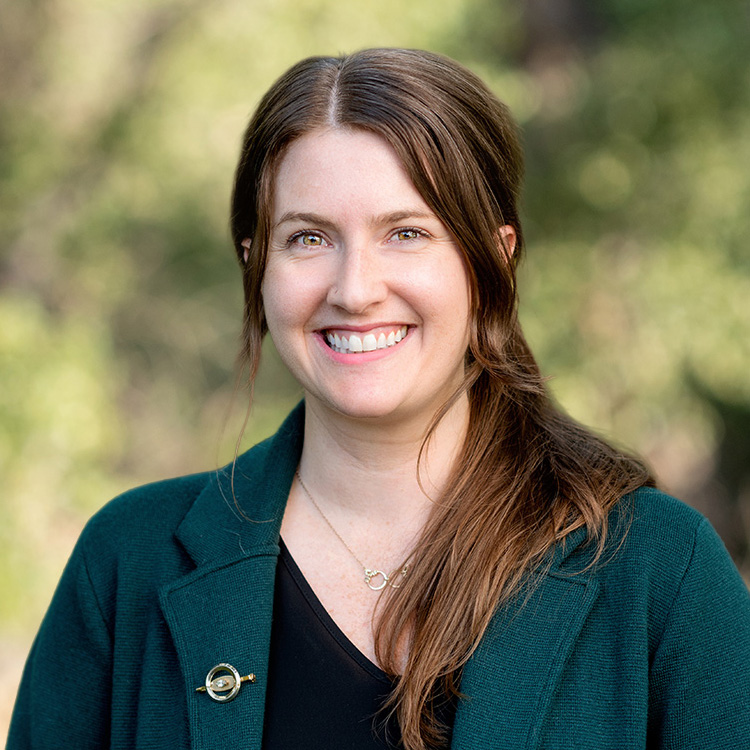 Kristin George Bagdanov
 Nicole KelnerCourtesy of Katy Tartakoff
What inspired you to write this story?
Kristin George Bagdanov (author): In spring 2023, I was back from parental leave and I was reading a lot of children’s books. There’s a great image in Richard Scarry’s Busy Busy Construction Site of all of these workers installing wires and building a house, and I thought, “I want this for an all-electric house!”
I pitched a children’s book as a fun idea to BDC’s Executive Director and Director of Communications, and they said “Yeah, let’s do it!” While talking through the best way to tell this story, we decided to partner with the unions that actually do the work of building electrification at the neighborhood scale.
After the unions came on board as collaborators, I reached out to Nicole. I was familiar with her work — her wonderful illustrations have gone viral so many times on social media, and she’d written in one of her recent newsletters that she wanted to do a children’s book.
Nicole Kelner (illustrator): I had been taking a six-week class in making children’s books at the School of Visual Arts in New York, so it was perfect timing. And I was so excited to hear about the partnership with the unions—it felt so unique and collaborative.
Nicole, what inspired you to dedicate your artistic talents to energy and the environment?
Nicole: I previously worked in education and technology. Ten years ago, I cofounded an after-school program to teach kids to code. I wanted to pivot into climate and eventually landed my first job at a climate startup.
After work I started painting for fun, and I did this challenge where I painted a watercolor a day for 100 days. On Day 10, I painted an illustration on kelp and carbon sequestration. People on Twitter seemed to like it, so I dedicated the rest of the 90 days of painting to climate topics. It seemed like a great way to communicate these complex topics about energy and the environment.
Why did you decide to highlight thermal energy networks (TENs) in the book?
Kristin: Sharing is such a key concept for child development, and it’s a concept they already get: you can give something to someone, and then they can give it back to you. Over and over again—a sustainable cycle of giving. Kids learn about this very early on. And of course, part of what’s so great and sustainable about TENs is that rather than extracting and combusting, you’re sharing and circulating energy.
We label thermal energy networks in the book, but we don’t use that technical term in the narrative itself. Instead, we talk about “sharing circles.” The key refrain in the book is about passing things “back and forth, back and forth.” At the end, this refrain symbolizes the neighborhood’s power in passing and sharing things. It’s how you make sustainable energy, but also a sustainable community that can share resources, ideas, strength, and resilience.
How was creating a children’s book different from the work you’ve done in the past?
Kristin: I work a lot with stakeholder coalitions on writing technical reports. Blending the technical with the creative for The Clean Green Neighborhood was a totally different experience for me. It’s not just about getting the data right. It’s about, “How does this book make someone feel? How does it make different types of people feel?” The book has loftier, more idealistic goals attached to it. We want it to inspire people. We want lots of different people to learn from it. We want people to feel included, seen, and represented. You don’t often get to say that out loud when you are very focused on data and outcomes.
Nicole: I love being able to make complex topics into something warm and cozy and approachable, and this was such an amazing opportunity to do that. Constructing an all-electric neighborhood is a pretty complex idea, and then you have to follow the guidance of “explain it to me like I’m five.” And we did it! Not just for literal five-year-olds, but also for their parents, too.
How did the union partners bring their expertise into the book?
Kristin: The union partners were the International Union of Operating Engineers Local 12, the International Brotherhood of Electrical Workers Local 11, the International Association of Sheet Metal, Air, Rail, and Transportation Workers Locals 104 and 105, and United Auto Workers Region 6. Representatives from each of these locals joined a Creative Advisory Board to provide feedback and oversight.
We started out with a little mutual education. Our Creative Advisory Board each shared about their local’s work. The BDC team did a presentation on thermal energy networks. After that, we started reviewing Nicole’s first black-and-white mockups.
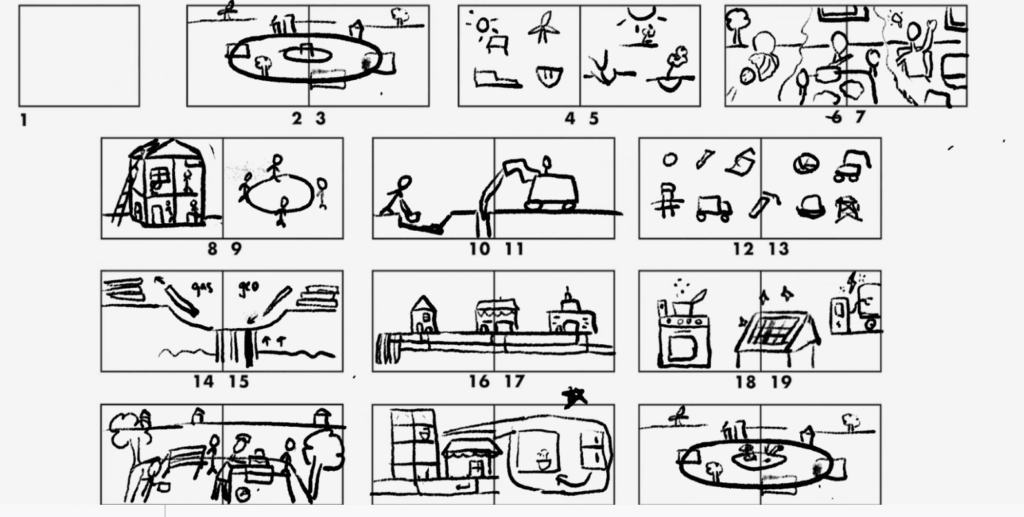 Story board of the whole book.
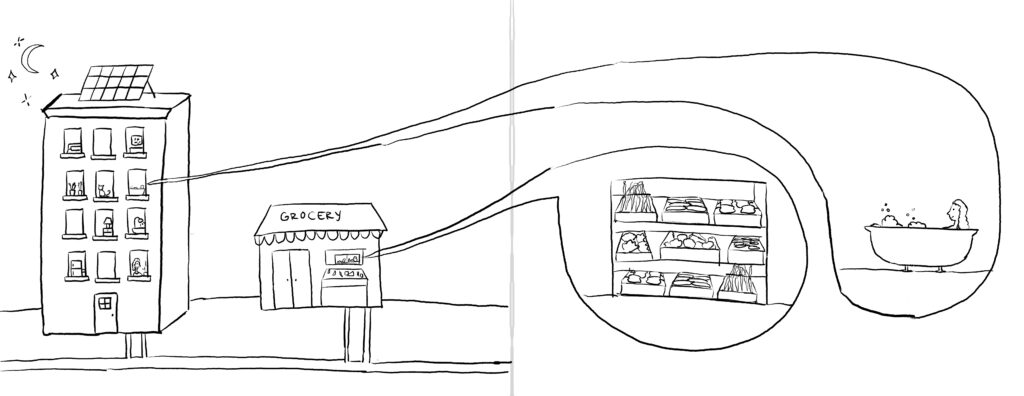 Black and White Mockup
It was interesting to see what the union partners noticed! They really wanted to highlight safety aspects of their work. The operating engineers wanted to add safety strips on the vests their characters were wearing. We added safety harnesses and construction signs in some illustrations as well. The union collaborators also pinpointed all of the details of their trades that were important to convey. They’d say, “Can you make that ditch a little wider?” Or, “Make this worker rest the pipe bender on their shoulder like this.”
Nicole: That’s what is special about this project. It’s inspired by Richard Scarry-type art, where the charm is that so much is going on, and you want to get lost in it. It’s like I Spy — every time you look at it, you notice something new.
Nicole, as you were illustrating, did any scenes take revision to get just right?
Nicole: I’ve been illustrating things like heat pumps and EVs for the past two years, so those are in my icon vocabulary already. But I didn’t know about thermal energy networks before this!
The hardest thing for me was drawing the people, because I hadn’t drawn a lot of people before this project. The pipe bender, on the page with all of the workers — I could not get the grip on the tool right. Our union collaborators were saying “It’s not quite right yet.” It took me four tries! But it was worth it, because we wanted the images of union workers with their tools to be just right for them.
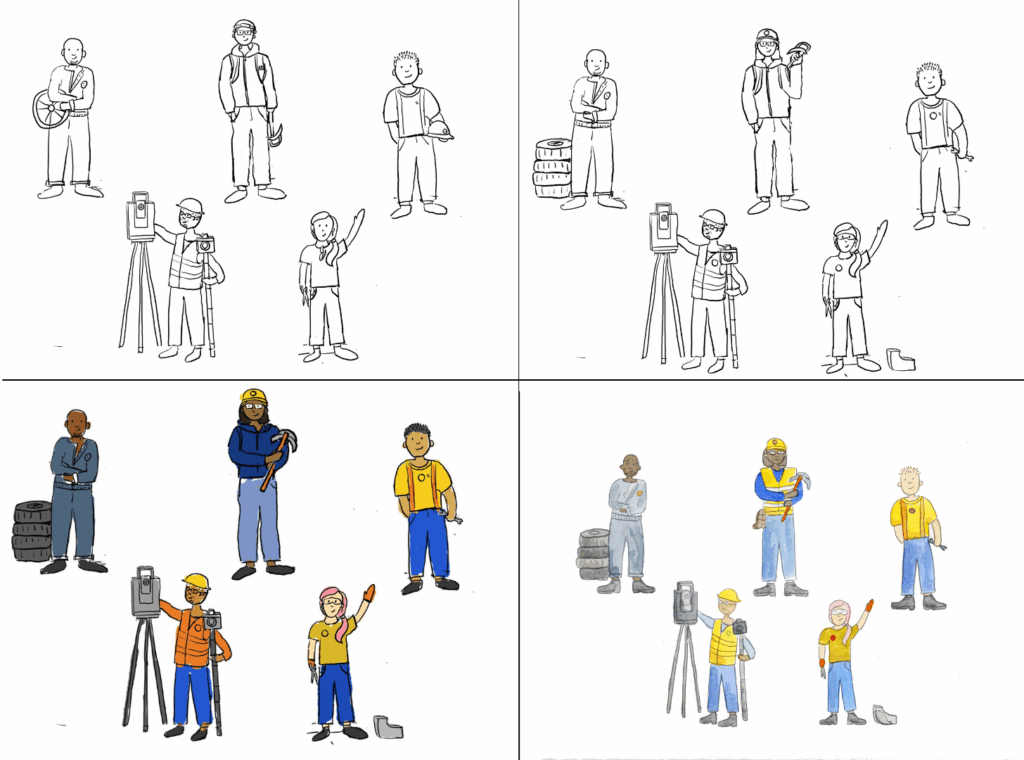
Phases of revision for union characters page.
Were any of the characters or illustrations inspired by real people or places?
Kristin: Yeah! Our Creative Advisory Board helped us create the characters. We used imagery from their websites or pictures they provided as inspiration. So all of the union worker characters are a composite of images of people that actually work for those unions.
The thermal energy network pilot in Framingham, Massachusetts also gave us fun inspiration. Our opening construction scene – the borefield with all of the pipes – was inspired by an actual photo of Framingham. Framingham also inspired us with their pilot ribbon-cutting photo. Zeyneb Magavi, the Executive Director of HEET, inspired the character holding the big scissors in our picture. And on the last page, the “thermal energy network fan” is based on Ania Camargo Cortes, our TENs expert.
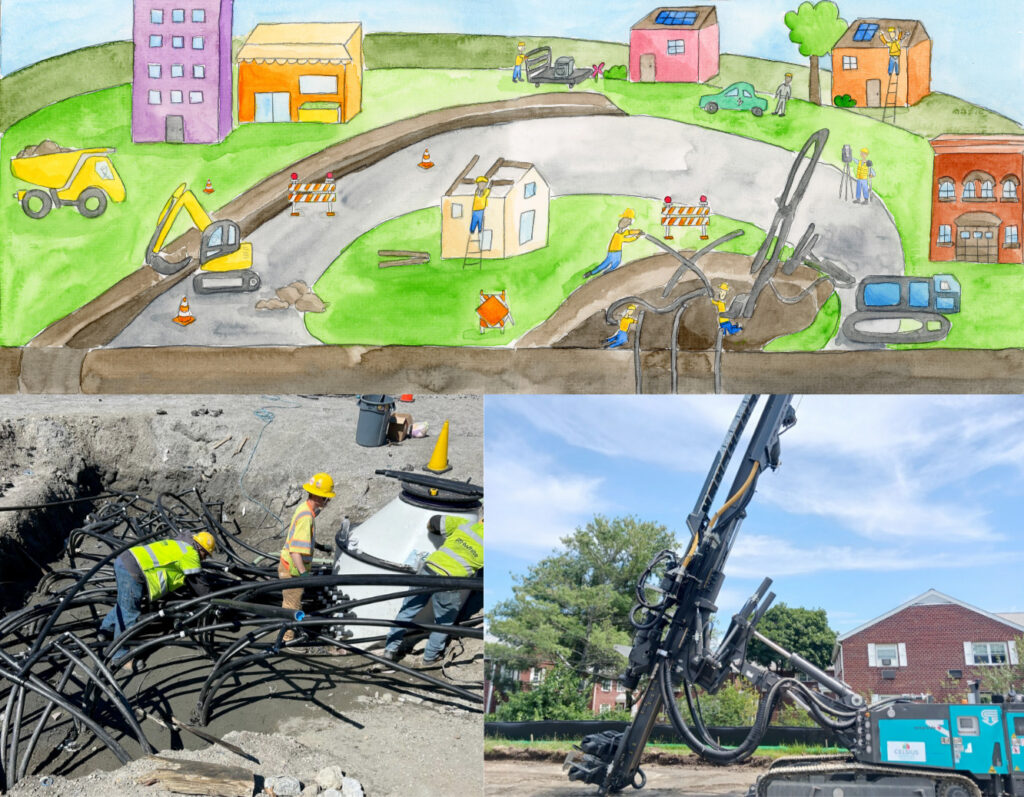
Opening scene with reference pictures from Eversource Framingham TENs pilot.Courtesy of Eversource Energy
What have been your favorite reactions to the book so far?
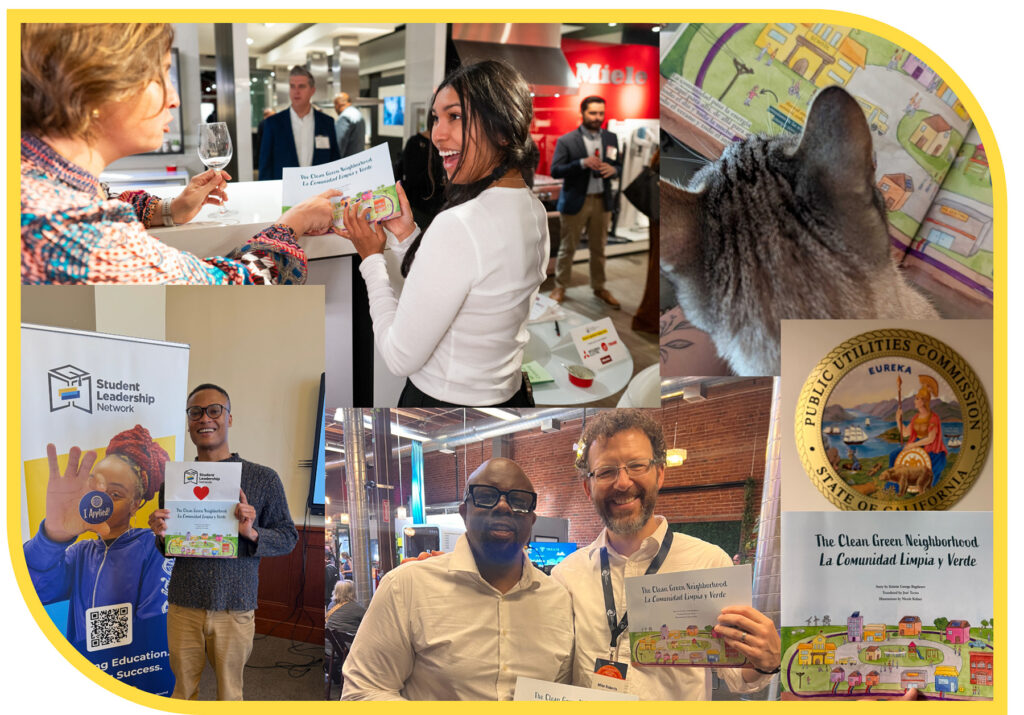
KGB: I read my daughter all of the drafts. I got to the page that says “Workers who do the same kind of work join together in a labor union.” She immediately said, “What’s a union?” and the very next sentence explains what it is. So that told me I was building the narrative right.
Her favorite page is the page with the long list of digging and drilling, laying and looping. I wrote that thinking about how kids like those excessive moments in stories that become silly and fun. Saying it out loud, with that rhythmic repetition, is very exciting for them. It was fun to see the things that I felt were good for the narrative and thought were also good for a child to actually be received in that way by her!
Nicole: My studiomate was next to me while I painted the whole thing. She was so excited to see it come together.
What will make you feel that this book is a success?
Nicole: To be able to explain topics like this to a five year-old and a ninety-five year-old through my art feels like a real win to me.
Kristin: I already feel like it’s a success! This project wasn’t just about the book, it was about building relationships and coalitions with our union partners and with Nicole, personally and professionally. We got to better understand the work that our union partners do, and share the vision of neighborhood-scale decarbonization with them. That is such a success already.
If you haven’t visited The Clean Green Neighborhood yet, you can purchase your copy here!

The Clean Green Neighborhood is a story about sharing energy, building power, and the union workers who make neighborhoods resilient and renewable. This book is written in Spanish and English and is intended for both children and adults. Written in collaboration with unions and printed by a union print shop in the U.S., this book embodies the vision of the world it seeks to create.
Buy
BDC stands with the people of Minnesota, and states across the country, in condemning the illegal actions of Immigration and Customs Enforcement
This past year has been one of brazen, divisive, and hateful actions by the federal administration against local communities. These lawless campaigns represent a breakdown in fundamental principles that underpin a healthy democracy and violate key protections of the U.S. Constitution: respect for human dignity, the rule of law, and the right of people to speak out and peacefully assemble without fear.
The Building Decarbonization Coalition unequivocally condemns violence in all its forms. The use of force against immigrant communities, communities of color, peaceful demonstrators, and bystanders undermines public trust, escalates harm, and weakens the democratic fabric we all depend on. Governments at every level have a responsibility to uphold the rule of law, protect civil liberties, and not cause unrest.
Our future depends on unity, not division. It depends on leaders choosing accountability, restraint, and transparency. And it depends on the sanctity of our democratic processes.
We stand with those calling for justice and accountability. We stand with our partners in Minnesota who are turning all their attention in this crucial moment towards protecting constitutional rights and justice. We affirm the right to peaceful assembly. And we call for an immediate end to unconstitutional actions and state-sponsored violence against immigrants, protestors, and other members of our communities.
We must uphold Constitutional values, protect human dignity, and recommit to systems that serve people with fairness, safety, and integrity.
For Immediate Release
Media Contact:
John Lindsay
john@moxiestrategies.com
Statement from the Building Decarbonization Coalition on New York Governor Hochul’s Executive Budget
ALBANY, N.Y. (January 20, 2026) — Allison Considine, New York Director for the Building Decarbonization Coalition (BDC), provided the following statement in response to Governor Hochul’s Executive Budget Address:
“While this budget makes many important investments to improve the lives of New Yorkers, including an initial $50 million for EmPower+, we are disappointed to see no investment made to advance thermal energy network projects on SUNY campuses. These programs support family-sustaining union jobs across the state and accelerate our transition away from fossil fuels. We are hopeful that the legislature will include support for these critical projects, as well as additional funding for EmPower+ and the Green Affordable Pre-Electrification Fund, in their one house budgets, and that a final budget agreement will include this funding. These programs will ensure equitable access to affordable energy to low- and moderate-income New Yorkers, making New York more affordable for all.”
###
ABOUT THE BUILDING DECARBONIZATION COALITION
The Building Decarbonization Coalition (BDC) aligns critical stakeholders on a path to transform the nation’s buildings through clean energy, using policy, research, market development, and public engagement. The BDC and its members are charting the course to eliminate fossil fuels in buildings to improve people’s health, cut climate and air pollution, prioritize high-road jobs, and ensure that our communities are more resilient to the impacts of climate change. Learn more at www.buildingdecarb.org