
Written by BDC and Sunstone Strategies
Congratulations, folks, we’ve just completed another trip around the sun! Glad you’re still on board. Next stop: 2026.
Before we step into the new year, 2025 deserves reflection and celebration. This has been a defining year for the building decarbonization movement that can be punctuated by a keyword: affordability.
Across the nation, households are experiencing rising costs on all fronts: at the grocery store, in their monthly rent, and on their utility bills. Rollbacks of critical federal funding for climate and energy assistance are tightening the squeeze on those already struggling to make ends meet. Voter frustration culminated in what’s been described as November’s “energy affordability” election, in which Democratic candidates swept races with a focus on lowering utility bills.
As AI, data centers, and demands for affordability clash to rewire U.S. politics, clean energy and energy-efficient homes and equipment are emerging as clear political winners. That’s because renewable electricity is the cheapest form of energy on the planet, and electric technologies are the most modern and energy-efficient technologies on the market. While we have plenty of work in front of us, we know that affordable, clean electricity—paired with modern and energy-efficient homes, buildings, and electric technologies—is the long-term affordability solution we need. Translating this formula into a reality for everyone will continue to drive our work into the new year and beyond.
As we look toward 2026, nothing is more motivating than progress. And we’ve made plenty of progress this year. So let’s take a look at the greatest hits of 2025, reflect on our wins, and prepare the path for a more affordable 2026.
Key Takeaways
- The leading driver of inflation? It’s not eggs.
- Gas infrastructure is an expensive problem. Electrification is the solution.
- The grid is cleaner than ever. Let’s keep it that way.
- Heat pumps are trending and the U.S. is leading.
- Specialized electric rates for heat pumps are saving households hundreds of dollars.
- Building decarbonization isn’t just for “blue states”— it’s taking off nationwide.
- Customers footing the bill for gas expansion and lobbying? Not anymore, say states.
- Removing gas line subsidies delivers affordability and more all-electric buildings.
- Electric Buildings go BIG.
- Thermal Energy Networks are hotter (and cooler) than ever.
- Electric building code innovation drives momentum.
- Clean technology keeps getting more accessible and more affordable.
- The future of kitchen design is here and powered by induction.
- Workers are the heroes we need to accelerate clean homes and buildings at scale.
- It’s easier than ever to find a qualified contractor to upgrade your home.
- The next generation is learning how to make their neighborhoods clean and green.
1. The leading driver of inflation? It’s not eggs.
If electricity is the new price of eggs, then gas is bird flu.
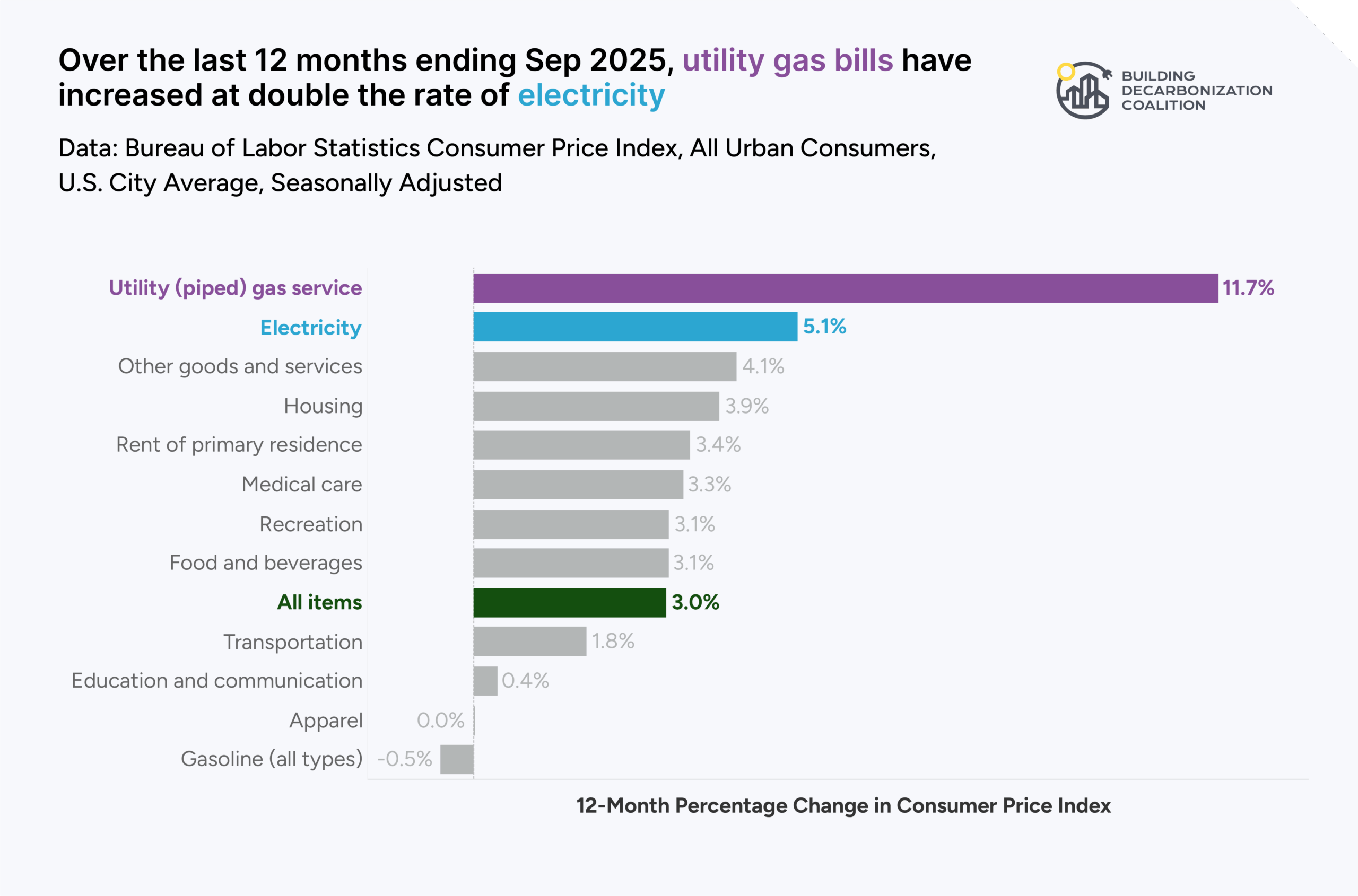
In the past year, gas bills have risen nearly 12%—more than twice as fast as electric bills, outpacing the rate of overall inflation by almost 400%. In fact, between September 2024-2025, gas bills increased more than the cost of groceries, rent, clothing, and medicine combined.
2. Gas infrastructure is an expensive problem. Electrification is the solution.
Even if households turn down their thermostats to save money this winter, their gas bills may continue to grow. That’s because most of your gas bill pays for what a utility builds–not what you use to heat your home.
Today, gas utilities are installing or replacing expensive gas pipelines below our feet, even as demand stagnates and declines. The charts below show how utilities have been ramping up new infrastructure (“gas plant”) even while customer demand and customer growth stagnate.
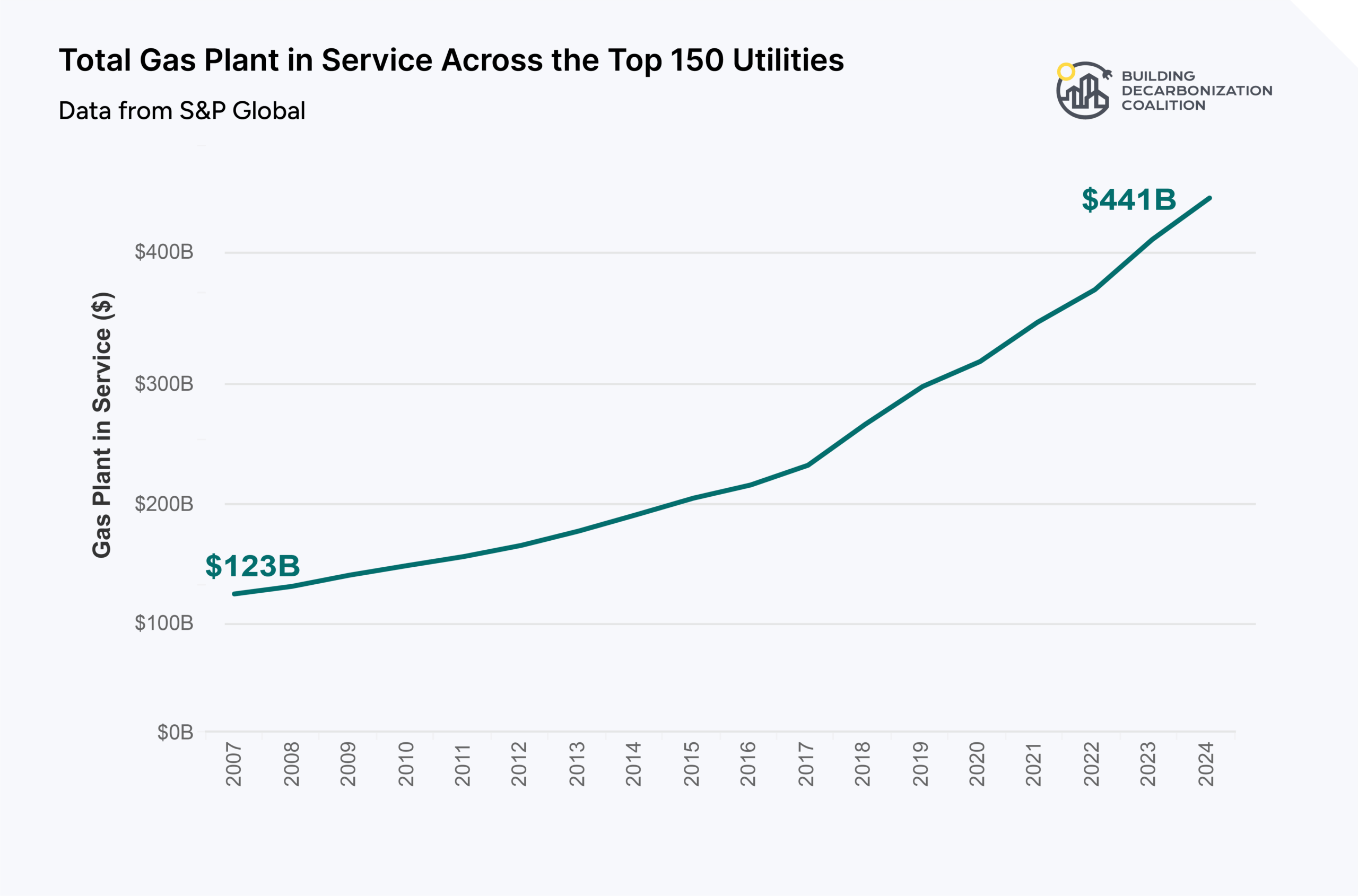
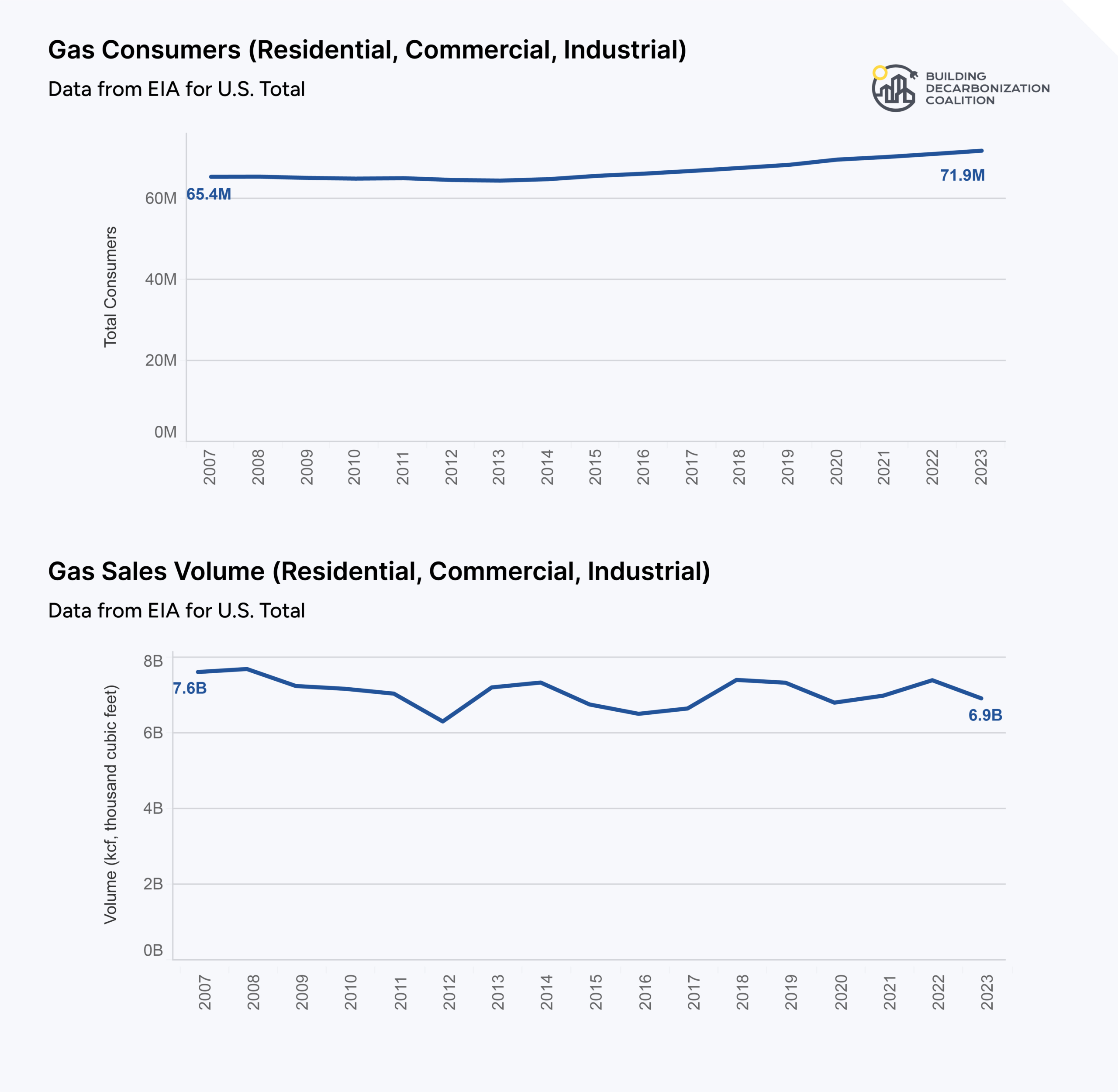
The cost of these new pipelines is passed on to households in the form of higher energy bills that will be paid for decades to come. In fact, on average, 66% of our gas utility bills go toward infrastructure projects like pipeline replacements. What this looks like is an annual bill of $21 billion that households are collectively paying for gas infrastructure, and by 2050, we’ll have spent $1.4 trillion on a system that is declining.
Why spend money on two energy systems when we only need one? Having separate gas and electric infrastructure might have made sense in 1905, but not in 2025. Today, electric appliances outperform and outsell gas appliances in almost every category.
The bottom line is that we don’t need polluting, expensive gas. We should only pay for the clean energy system that we need: a resilient electric grid paired with thermal energy networks.
3. The grid is cleaner than ever. Let’s keep it that way.
To lower costs for households, we need to focus on the supply side of electrification (the grid) as well as the demand side (how our buildings use energy). To power our grid with the most affordable type of energy out there, our electricity must be generated by abundant and clean renewable energy sources like wind and solar.
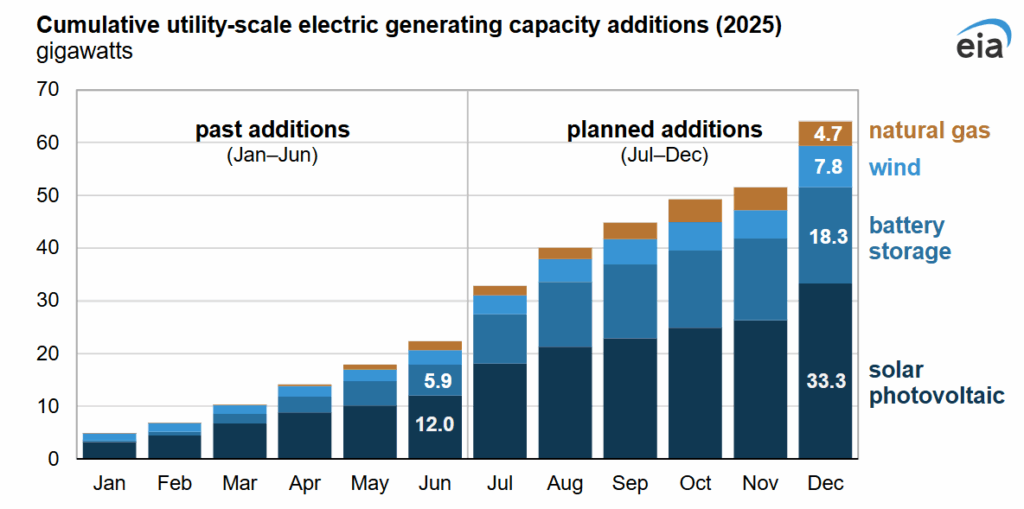
In 2025, we saw the supply side invest in new clean energy projects that will affordably power the grid. Nearly 93% of new capacity came from renewables such as solar, battery storage, and wind. This incredible boom contrasts greatly with the turn of the century, when clean technologies made up less than 5% of new capacity. It’ll take all of us to keep this trend moving in the right direction, especially as fossil fuel interests attempt to turn the clock back to coal and methane gas plants.
4. Heat pumps are trending and the U.S. is leading.
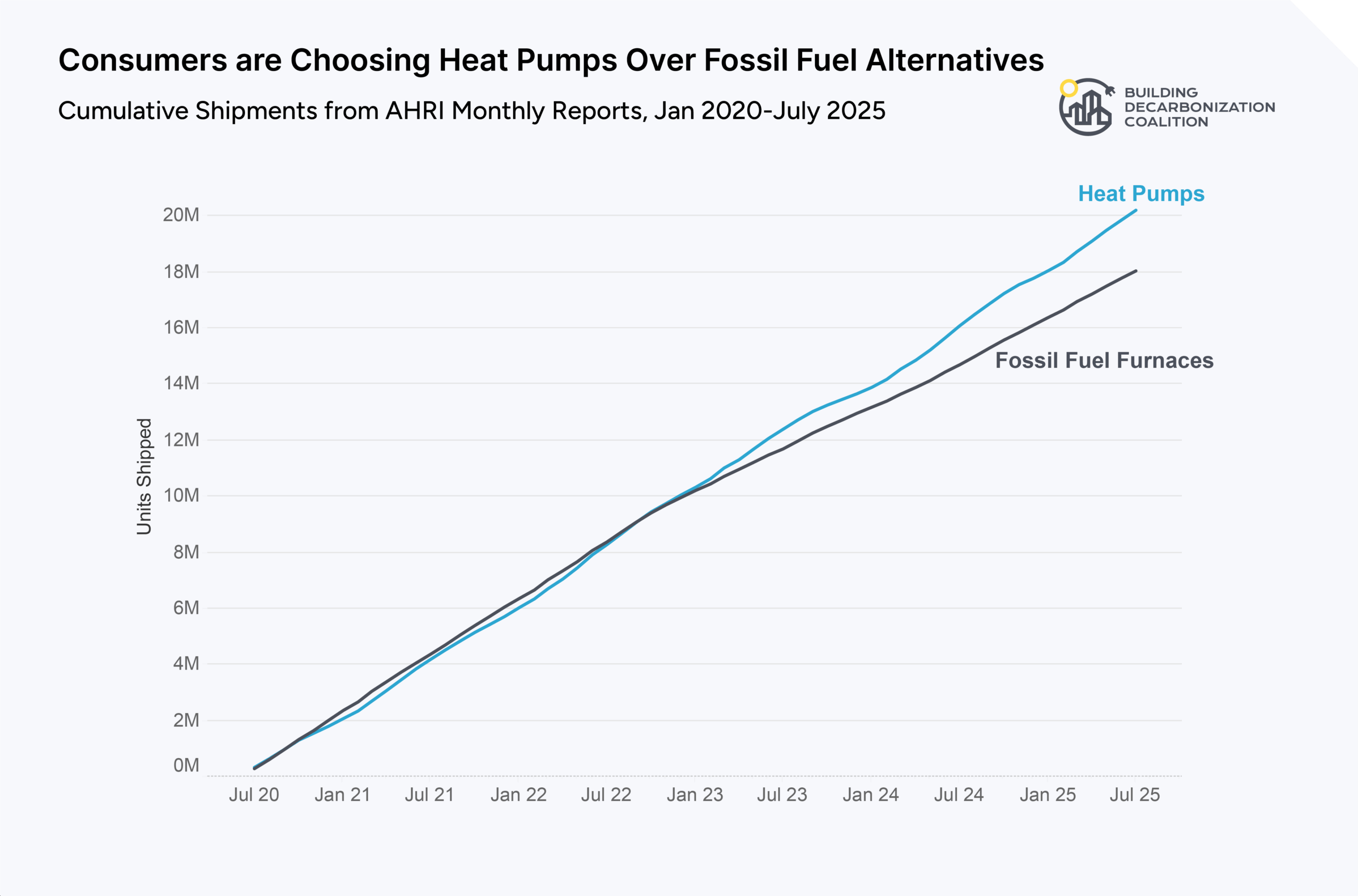
Back on the demand side, we are excited to see that after years of growing sales, the U.S. passed China to become the number one market for heat pumps in the world this year. And it’s no wonder that households love heat pumps or why 90% of heat pump owners would recommend them to a friend. Heat pumps are three to four times more efficient than gas furnaces, which reduces energy use and lowers monthly utility bills.
The rise of the heat pump market shows how households are choosing highly efficient, affordable heating and cooling options. This year, heat pumps once again outsold gas furnaces, a trend that’s occurred three straight years in a row. Encouragingly, heat pump sales are also closing the gap on air conditioning systems.
5. Specialized electric rates for heat pumps are saving households hundreds of dollars.
According to The New York Times, nearly 80% of American households can save on their energy bills right now by upgrading to heat pumps. But that number, and the amount of savings, can be magnified thanks to specialized electric rates.
Households with heat pumps benefit their neighbors by helping to subsidize more costs related to grid infrastructure. Creating specialized electric rates takes this into account and lowers the costs of operating a heat pump. A 2025 study found that heat pump customers switching to electrified heating rates could lower their energy bill by $240 annually on average.
Today, more than 17 utilities have heat pump-specific rates and another 76 have broader electrified heating rates that are saving heat pump users hundreds of dollars. Massachusetts utilities are the most recent to launch a heat pump rate, which is projected to save heat pump owners an average of $540 this winter.
6. Building decarbonization isn’t just for “blue states”— it’s taking off nationwide.
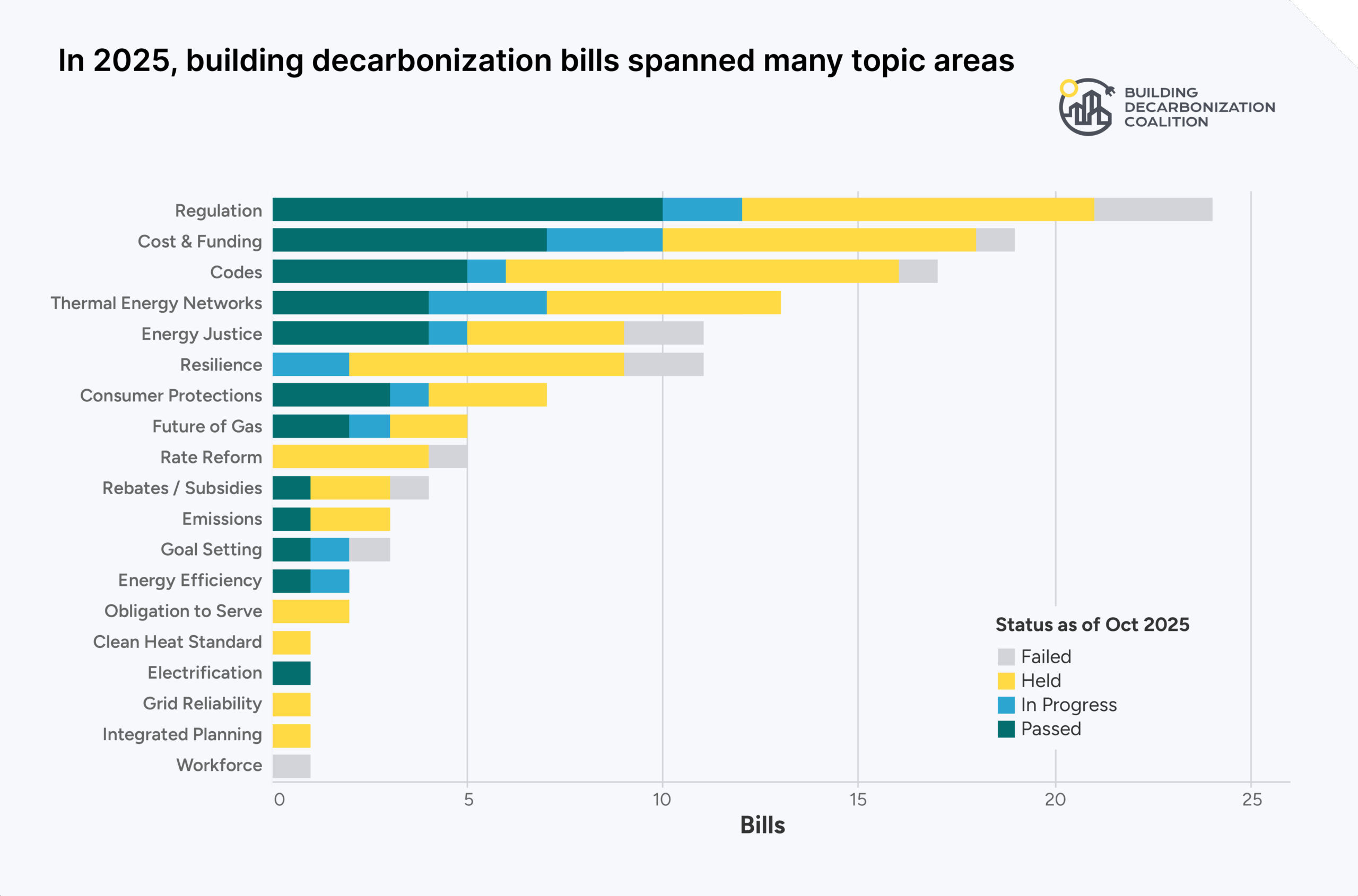
From Texas and New Mexico, to New York and Illinois, 130 bills were introduced advancing building decarbonization in 2025, with 41 passing. See highlights of some legislative wins this year:
- IL SB25: Illinois lawmakers recently passed The Clean and Reliable Grid Act during the veto session, which will allow the state’s climate bank to finance $20 million for thermal energy network projects. The legislation also includes key provisions that will advance clean energy in the state, including energy storage procurement targets, energy storage rebates, virtual power plants, interconnection reforms, load energization timelines, and thermal energy networks.
- NY A88888/S8417: A grassroots-led effort by the Renewable Heat Now campaign and allies like BDC resulted in the passage of legislation, awaiting signature by the Governor, that ended the 100-foot rule—an unfair, outdated rule that allows utilities to profit by charging existing customers for the cost of extending gas pipelines to new customers, which costs New York ratepayers $581 million on their energy bills each year.
- CA AB 39: Requires cities and counties to develop local building electrification plans, expanding access to clean energy technologies like heat pumps and EV charging.
- MD HB 1035: In one of two major energy bills passed this year, lawmakers passed legislation that would rein in utility bills by limiting spending on the gas system previously authorized under a 2013 law. The legislation would also increase grid resilience through battery storage and reduce data center cost shifting.
- TX HB 4370: Amends the Texas Local Government Code to designate geothermal infrastructure, including neighborhood-scale thermal energy networks, as Public Improvement Projects, which allows utility and non-utility entities (e.g. municipalities, water districts, and others) to own and operate geothermal infrastructure and to finance them through public bonds.
- NM HB 2: This budget bill establishes funding for key climate initiatives such as geothermal project development ($10 million) and a Community Benefit Fund ($209 million) to finance a wide array of climate projects, including ones that support fossil fuel transition.
In addition, three states passed legislation that will address the Future of Gas, six bills were passed that proposed innovative and equitable solutions for modernizing homes with efficient electric technologies, and 17 bills were proposed to support cost-effective, energy-efficient upgrades for entire neighborhoods at once.
7. Customers footing the bill for gas expansion and lobbying? Not anymore, say states.
States are leading the way toward the clean, affordable future we deserve by putting the brakes on unnecessary gas spending.
This year, legislators and regulators in Oregon, New York, and California ordered utilities to stop charging customers for their lobbying and marketing campaigns.
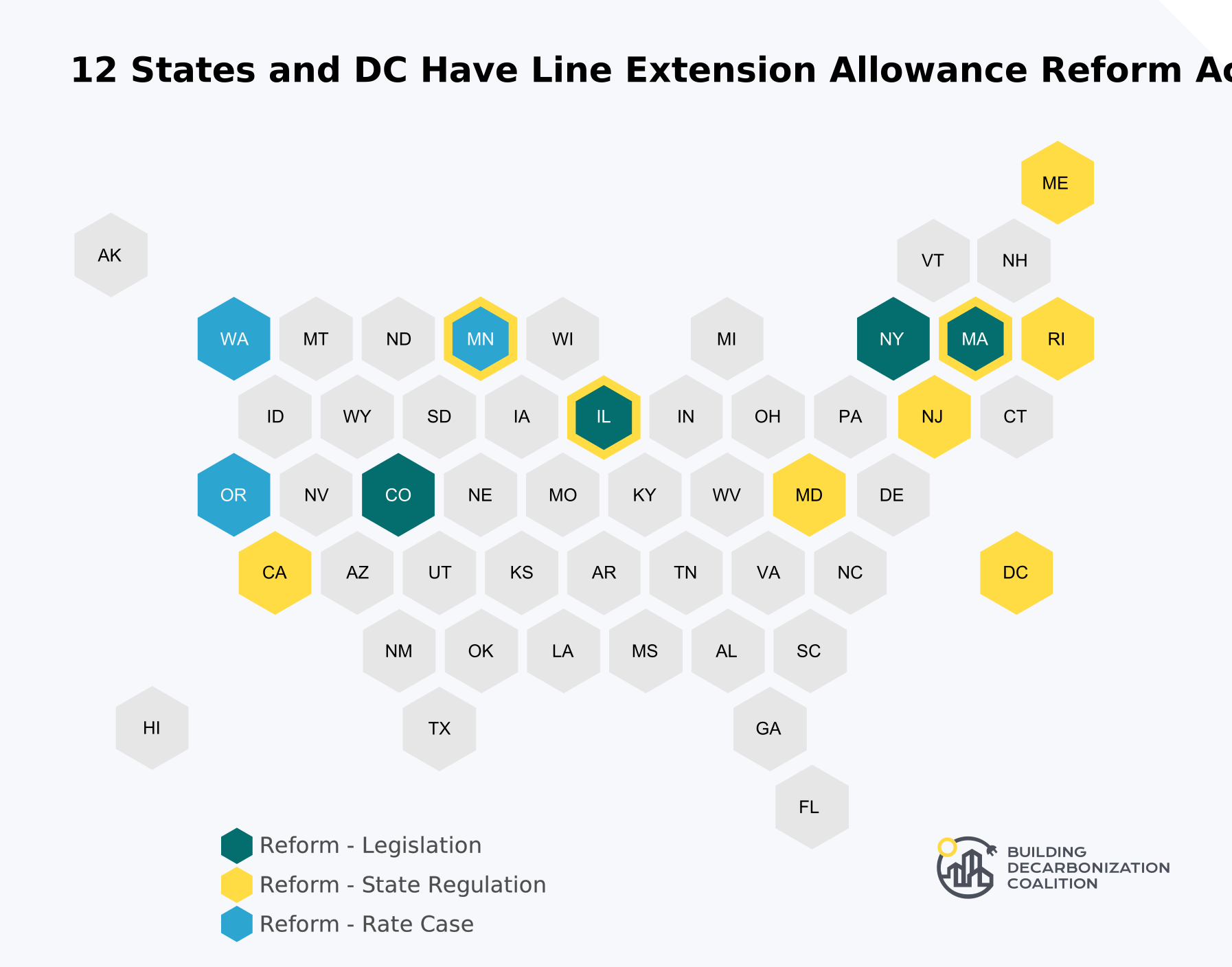
On top of that, twelve states and D.C. are currently working to end line extension allowances, an outdated, unfair rule that allows gas corporations to charge existing customers for the cost to extend gas pipelines to new customers. Ending this practice across the U.S. could save existing customers up to $7 billion and slow the unnecessary expansion of the gas system.
8. Removing gas line subsidies delivers affordability and more all-electric buildings.
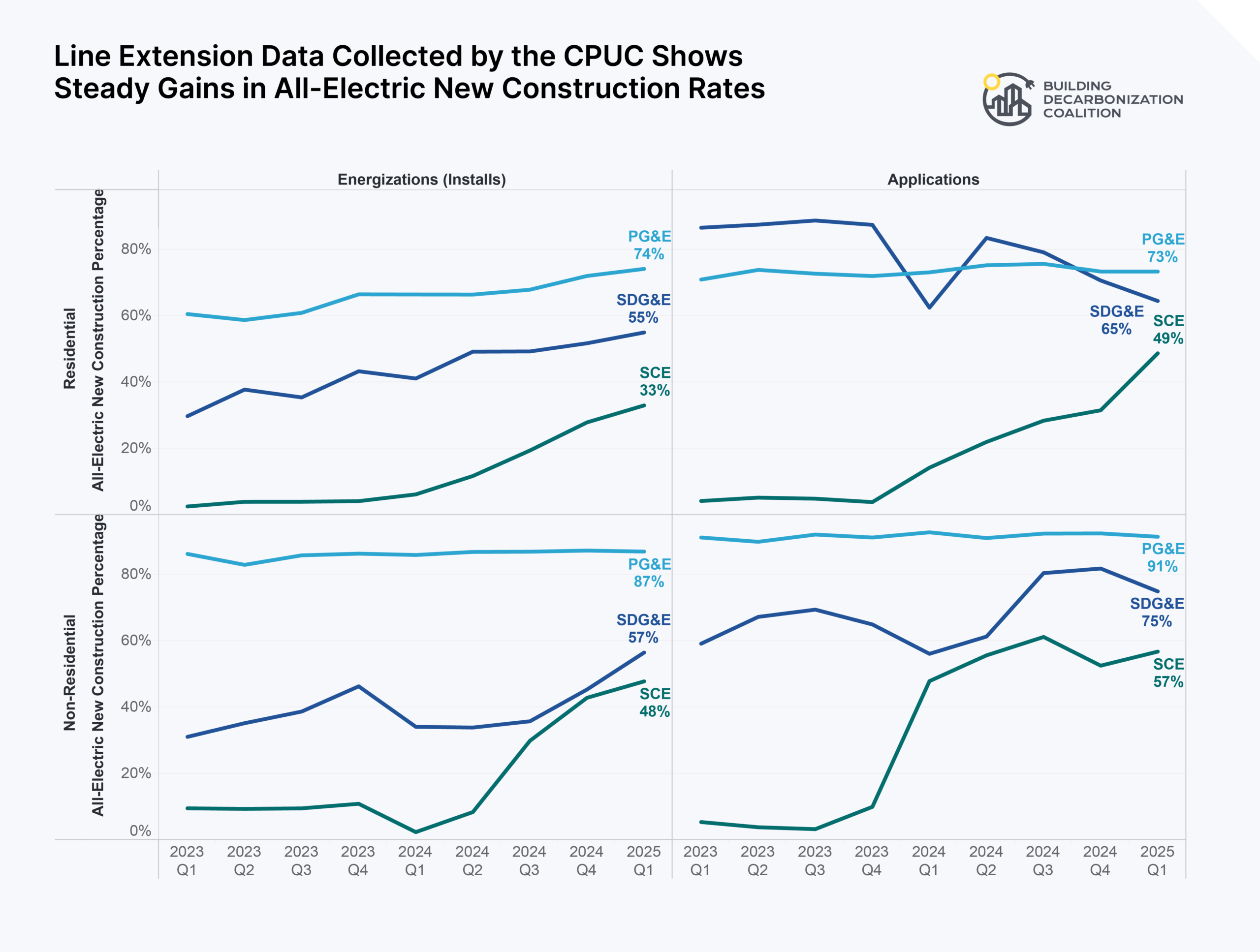
Removing these unfair gas subsidies has already kick-started a surge in constructing all-electric homes, which are cheaper and faster to build, helping deliver on affordability.
In California, in the two years after the state ended gas line extension allowances, the new construction market shifted significantly toward all-electric construction in all three major investor-owned utilities in California.
|
Percentage of Applications for All-Electric New Construction as of Q1 2025 |
||
|
Residential |
Non-Residential |
|
|
Pacific Gas & Electric Company |
73% |
91% |
|
San Diego Gas & Electric Company |
65% |
75% |
|
South California Edison Company |
49% |
57% |
For reference, just 8% of homes were all-electric in California, according to 2020 data. The increasing popularity of all-electric buildings in the Golden State shows that developers understand that building all-electric is cost effective and efficient and that consumers want efficient, affordable electric appliances. We expect this trend to transfer to the five other states that have just eliminated line extension allowances.
Ending these costly mandates is also encouraging the construction of affordable, healthier, and more resilient all-electric homes that families will enjoy for decades to come.
9. Electric Buildings go BIG.
The workplace of the future is all-electric. JP Morgan’s new headquarters, launched in October of this year, is the largest all-electric tower in New York. It comes just one year after New York’s first all-electric residential skyscraper launched in Brooklyn. It’s not just new construction. Investments to decarbonize large existing buildings are picking up as well. New funding in New York to advance low-carbon heating system retrofits and the introduction of AtmosZero’s drop-in heat pump boiler is helping to affordably expand decarbonization efforts to larger buildings.
When the All-Electric Building Act goes into effect, New York’s new buildings under seven stories will be constructed with efficient and affordable all-electric appliances. While the law is currently facing an implementation delay due to a legal challenge, the NYS Building Code Council approved a code this summer that includes all-electric new construction, in particular highlighting the cost savings for consumers and the cost-effectiveness of the policy. Advocates are continuing to highlight the opportunity to save consumers money while ensuring healthier, safer, cleaner new development.
10. Thermal Energy Networks are hotter (and cooler) than ever.
We’ve said it before and we’ll say it again: Framingham is the Disney World of building decarbonization.
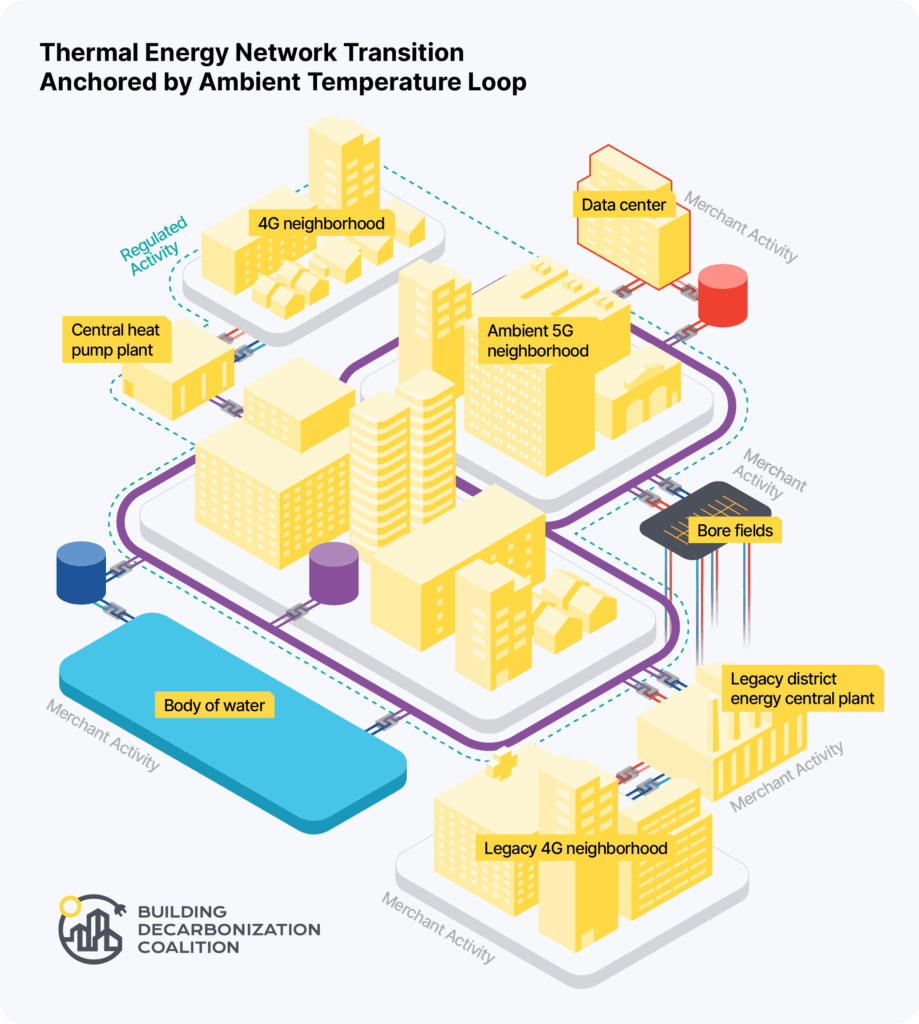
This Boston suburb is home to the nation’s first utility-led thermal energy network (TEN), which celebrated its first anniversary of operation this summer. TENs are our favorite way to electrify on a neighborhood scale because they can lower energy bills, improve air quality, ease strain on the grid, slash climate pollution, and create good-paying jobs. (Read more about TENs here.)
One in four states has now passed legislation related to thermal energy networks—whether it advances studies of TENs, unlocks new avenues for financing, or all-out requires regulated utilities to pilot TENs. In addition, TENs remain eligible for federal tax credits, despite rollbacks on other clean energy technologies.
And twenty-six utility-led TENs pilots are currently advancing through eight states: Colorado, Maryland, Massachusetts, Minnesota, New Jersey, New York, Washington, and Illinois. These pilots join the many non-utility-led TENs already under construction or operational in cities and campuses nationwide.
As TENs pilots like Framingham succeed in winning over customers, communities, lawmakers, and executives, we’ll see a paradigm shift in which gas utilities transition from distributing gas to distributing heat, including heat from geothermal sources.
11. Electric building code innovation drives momentum.
Here’s a trivia question: what’s the best time to upgrade to a highly efficient heat pump?
If you answered “when your AC breaks down,” you got it right!
Alongside states, cities are also playing a crucial role in advancing building decarbonization through innovative means. A growing number of local jurisdictions in California are encouraging the adoption of highly efficient heat pumps when household air conditioning systems fail. The strategy maximizes an opportunity to leverage the timing when necessary wiring, electrical capacity, and space are already in place to seamlessly install a heat pump without extra costs for households.
As of December 8, 13 cities in the Golden State have passed some version of “A/C to Heat Pump” building codes, demonstrating how cities are stepping up with innovative strategies to deliver efficient, electric appliances to households. According to BDC’s Why Cooling is Key report, if every California household installed a heat pump when their AC failed, and used it to replace a gas furnace, 51% of home heating and cooling in California could be electrified by 2030. This not only helps provide efficient and affordable cooling for households, it can be life-saving during extreme heat.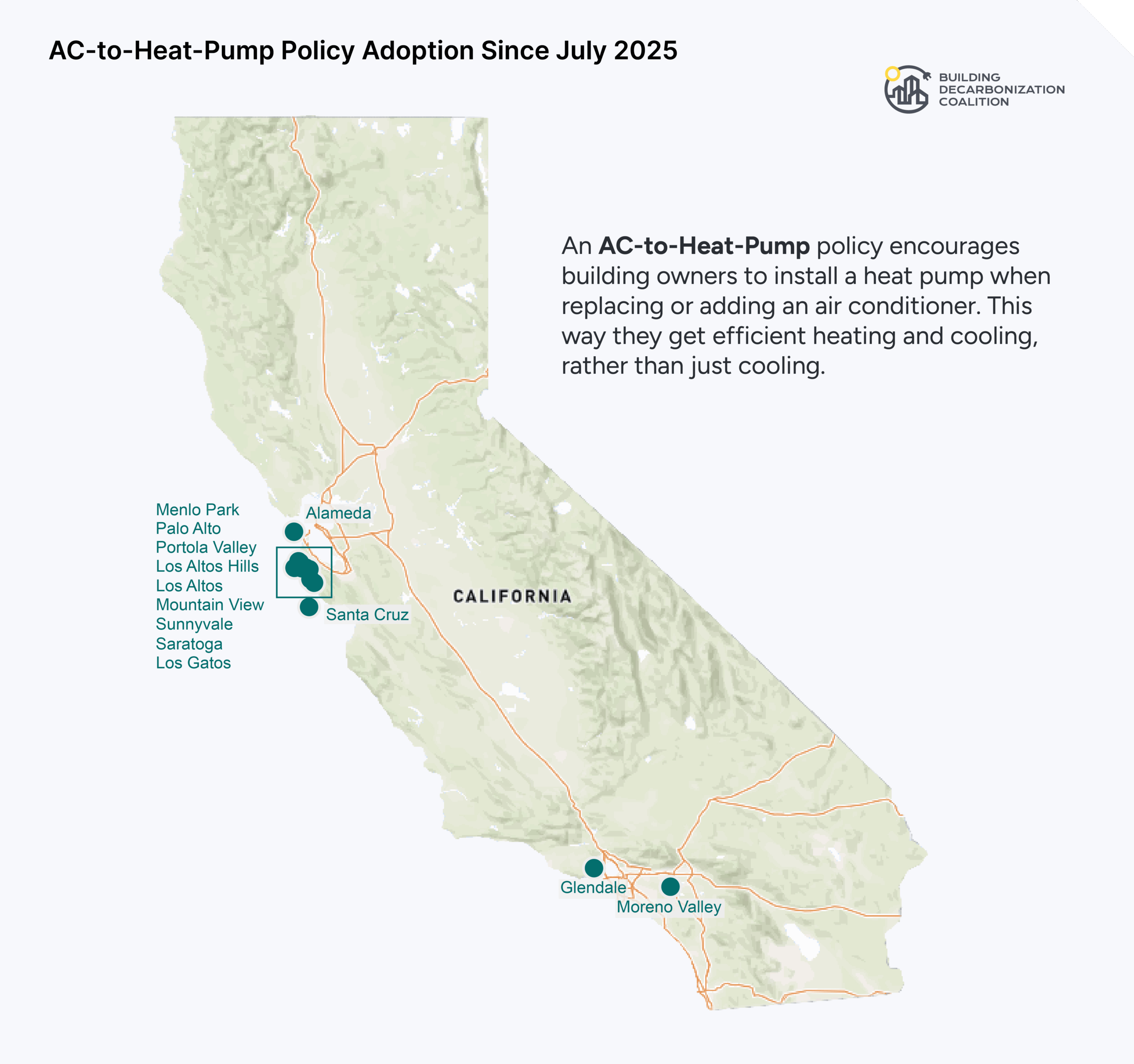
12. Clean technology keeps getting more accessible and more affordable.
Small living space? Low-voltage outlet? Large, multifamily apartment building?
No matter your living space, new models of efficient, electric appliances are making it easier than ever for households to decarbonize. GE recently introduced a 120V heat pump water heater that can be installed with any type of wall outlet; in addition “the 120V models can be field converted to 240V, so it can be placed on a 20 amp dedicated circuit, which is ideal for older homes with only 20 amps on 240V,” according to GE. Summit Appliance just came out with a two-zone, 115V induction cooktop for small kitchen spaces. In Massachusetts, cities are piloting window heat pumps for affordable retrofits in hundreds of multifamily apartment building units. In California, the state is going all in on affordable, efficient, and renter-friendly appliances, allocating $115 million for lower-income residents to install window-unit heat pumps and plug-and-play 120V induction stoves. Meanwhile, the New York City Housing Authority is replacing gas stoves in public housing with 10,000 energy-efficient, 120V battery-equipped induction stoves from Copper.
With newer models of clean technologies coming to market, costs will come down. Already, Jetson, a Vancouver-based heat pump startup, is using a new direct-to-consumer approach that cuts heat pump installation costs in half.
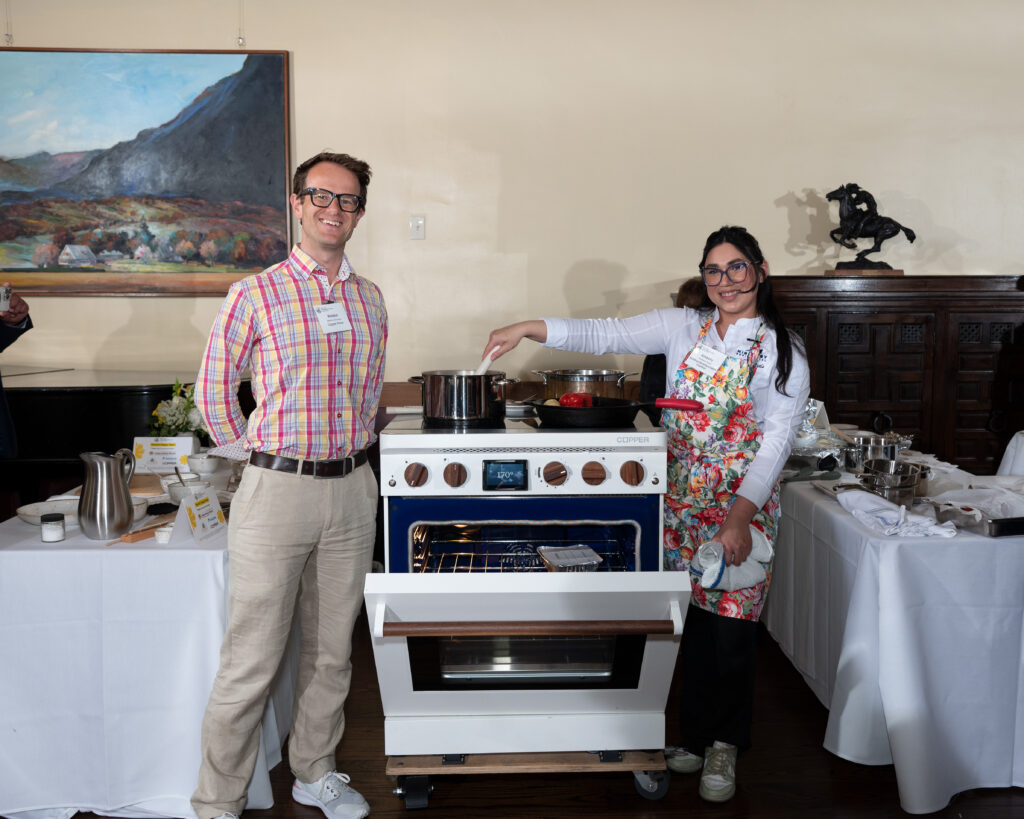
Chef Kimberley Ayala and Copper Co-Founder and CMO Weldon Kennedy demonstrate the power of Copper’s 120V stove at the 2025 Electric Happy Hour in Sacramento, CA.
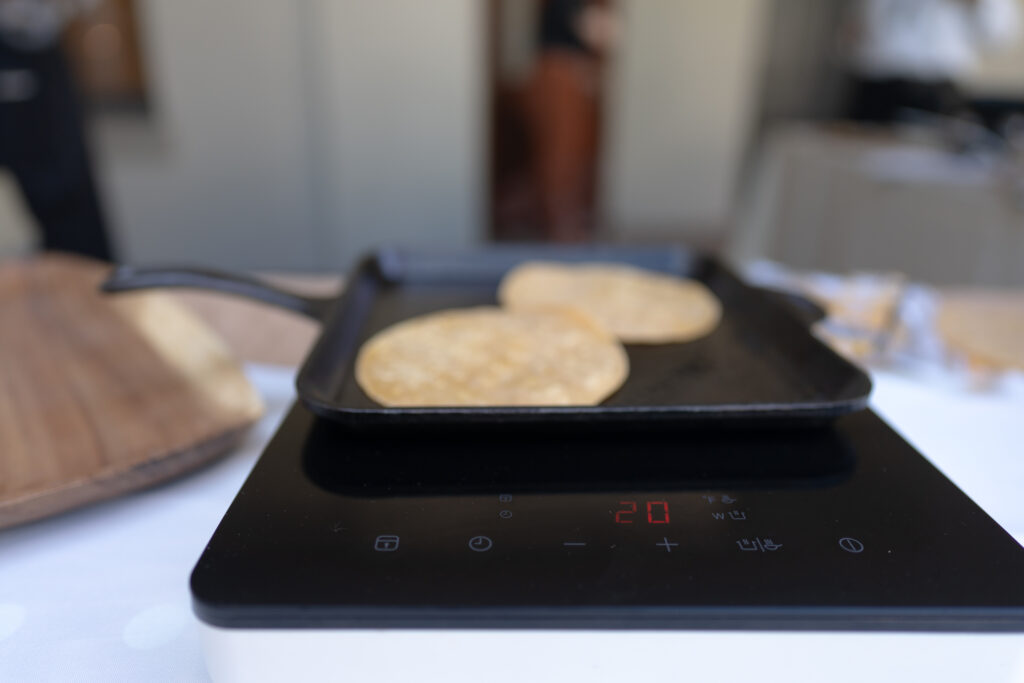
An affordable and portable induction hob chars tortillas.
13. The future of kitchen design is here and powered by induction.
Induction cooking is taking over one dish at a time. Already the favorite of notable chefs such as Eric Ripert, Alton Brown, and Jon Kung, induction stoves are now dominating the future of home cooking and design. Nearly two out of every three kitchen designers attest that within the next three years, induction will be the most popular way to cook, according to the National Kitchen & Bath Association’s 2025 Kitchen Trends Report. And House Digest is already forecasting that induction will be 2026’s Big Kitchen Trend.
The numbers back these projections, too. The U.S. is the fastest-growing market for induction stoves, and growth is expected to increase at an average of nearly 8% annually over the decade. The offerings continue to expand with innovation, including Novy’s “invisible” counter hob, Samsung’s minimalist induction stove with a concealed exhaust duct, and GE’s induction range with a dynamic and seamless “Griddle Zone.”
14. Workers are the heroes we need to accelerate clean homes and buildings at scale.
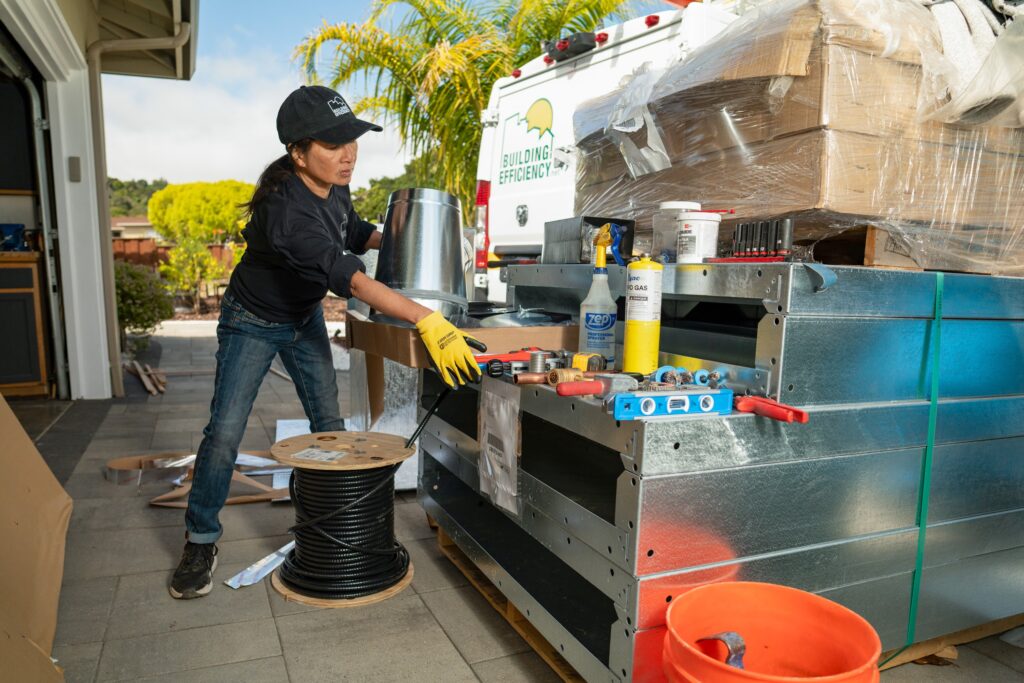
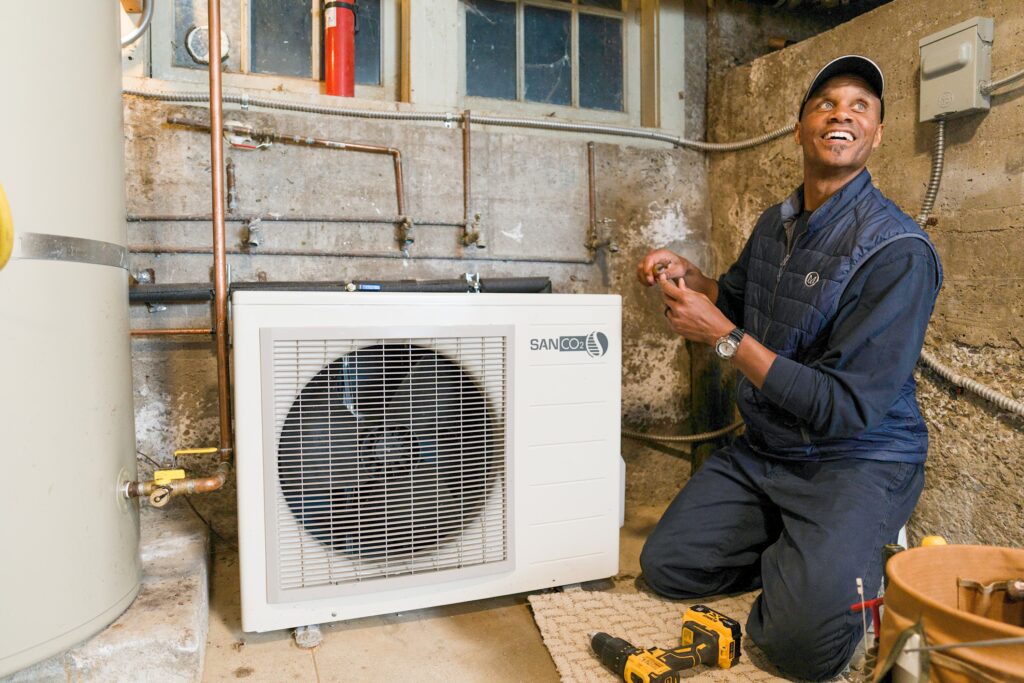
No heat pump or thermal energy network ever installed itself. The success of the building decarbonization movement depends on the HVACR and plumbing workforce.
Thankfully, the U.S. clean energy workforce is growing. Student enrollment in two-year HVACR associate degree programs jumped nearly 30%, with about 25,000 enrolled students, compared to last year. Plumbing enrollment at two-year colleges rose over 20%.
Our future HVAC technicians, plumbers, and pipefitters will be essential to installing and maintaining heat pumps for homes and businesses, and realizing the clean energy transition.
15. It’s easier than ever to find a qualified contractor to upgrade your home.
With more and more contractors entering the field, there’s never been a better time to upgrade your home. BDC’s The Switch Is On contractor finder has over two thousand qualified contractors available in California, New York, and Washington. You can conveniently connect with a professional to get expert, personalized advice tailored to your project. And with the handy incentive finder, you’ll be able to explore rebates in your zip code.
16. The next generation is learning how to make their neighborhoods clean and green.
The building decarbonization movement is built on progress. And we’ll need future generations of leaders to carry the work forward.
That’s why BDC partnered with four building trades and manufacturing unions to produce a children’s book about the workers who transform our neighborhoods with clean energy infrastructure. We hope that focusing on the generations to come will build a broader understanding of the movement and the workers who make the clean green transition possible.
 As we close out 2025, this project reminds us why we do this work: we’re building a world where the next generation can breathe easier, dream bigger, and inherit thriving, resilient communities powered by affordable clean energy. With that spirit guiding us, we look to 2026 with renewed purpose and a belief that the story we’re writing together is only just beginning.