
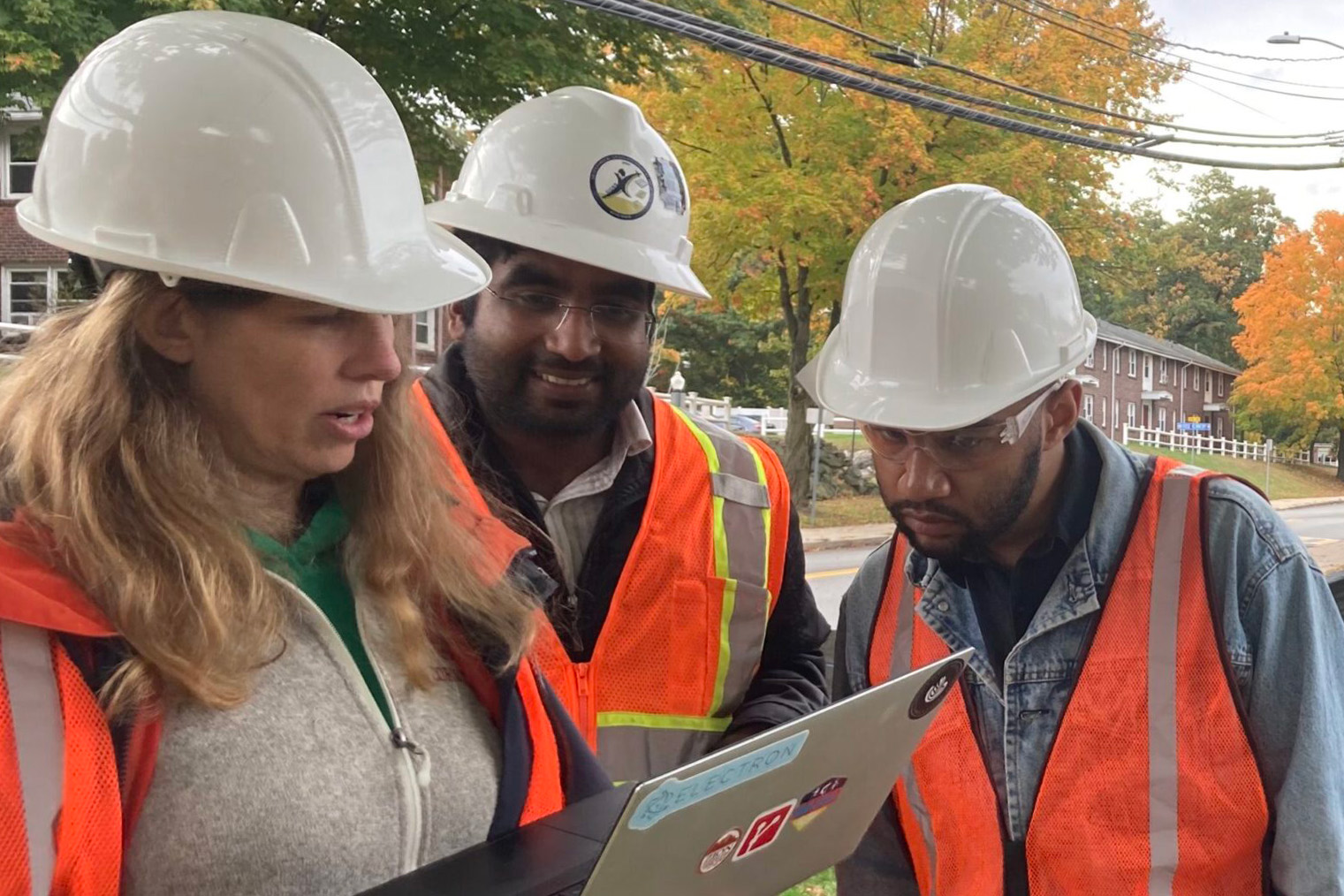
From left to right: Asha Nigh, Sumeet Sinha and Eric Juma onsite in Framingham. Image credit: HEET.
|
Quick stats:
|
“We said we wanted to do this, and Eversource saw that we had buy-in.”
Shawn Luz, Sustainability Coordinator, City of Framingham
From Gas to Geo
Massachusetts has a leak-prone gas pipeline problem: Miles of aging pipes leak methane across the state. Home Energy Efficiency Team (HEET), a nonprofit based in Boston, wanted to change this.
In 2017, HEET began pitching a new concept to gas utilities. They called it “gas-to-geo:” transitioning leak-prone gas pipelines to utility-scale geothermal pipelines that can heat and cool multiple buildings. HEET Co-Executive Directors Zeyneb Magavi and Audrey Schulman brought their case directly to Bill Akley, President of Gas Distribution Operations at Eversource Energy. And in Akley, they found an ally.
Eversource Energy is one of the state’s largest gas utilities. The company understood that, in a state with ambitious climate policies, they needed to explore cleaner alternatives. Akley listened to Magavi and Schulman, and in October 2020, the utility proposed a ratepayer-funded geothermal network demonstration project with Nikki Bruno, Vice President for Clean Technologies, leading the effort. The state’s Department of Public Utilities (DPU) approved the project the following year.
Bruno believes gas utilities have a real stake in the clean energy transition, but they must be willing to acknowledge it. Thermal energy networks (TENs) offer these utilities an opportunity: a scalable, pipe-based decarbonization solution that keeps their workforce employed, complies with state and local climate laws, and responds to consumers’ increasing desire for clean energy. And while TENs are a form of building electrification, it makes sense for a gas utility to handle thermal energy infrastructure, Bruno says. “We have franchise rights to operate in the street,” she points out. “And thermal energy acts like gas, flowing through pipes. It’s the same concept, but the borefields make that energy hyper-local.”
And she wants to show it’s good for business. “We have commercial customers telling us ‘If we can front the costs for geothermal, then it makes fiscal sense. We’ll save money in the long run.’ If that’s the case, then there is no reason why a utility can’t make the math work, too. If you can prove the cost savings and benefits to the grid, then we have a math rationalization—not just a climate rationalization.”
“If you can prove the cost savings and benefits to the grid, then we have a math rationalization—not just a climate rationalization.”
Nikki Bruno, Vice President for Clean Technologies, Eversource Energy
Separate Entities, Shared Goals
When Shawn Luz, Sustainability Coordinator for the City of Framingham, learned that Eversource was seeking a pilot neighborhood for the DPU-approved geothermal network, he saw an opportunity.
He had previously worked on a study with the Massachusetts Clean Energy Center to explore microgrids in two areas of Framingham, so city staff already had valuable information about building stock and neighborhood energy needs.
Luz then attended a geothermal-focused community charrette hosted by HEET, which was “amazing,” he says. The charrette reinforced that almost anyone can assess a neighborhood’s geothermal network suitability by using Google Maps, studying building types, and identifying areas with dense, diverse energy loads. (Click here to read HEET’s full list of charrette reports.)
The next step was to confirm which anchor institutions could strengthen a project’s viability. “In our case, the key anchor tenants were the Framingham Housing Authority, the fire station, and the school,” Luz explains. Each had parking lots that could host geothermal borefields and could directly benefit from participating.
The groundwork was in place. Framingham decided to act. “We said, ‘Hey, this is an awesome opportunity for this neighborhood, and we already know so much about it—let’s throw our hat in the ring,’” Luz remembers.
He scheduled a Zoom call with Bruno. “I brought every key stakeholder to that call,” he says. “We said we wanted to do this, and Eversource saw we had buy-in.”
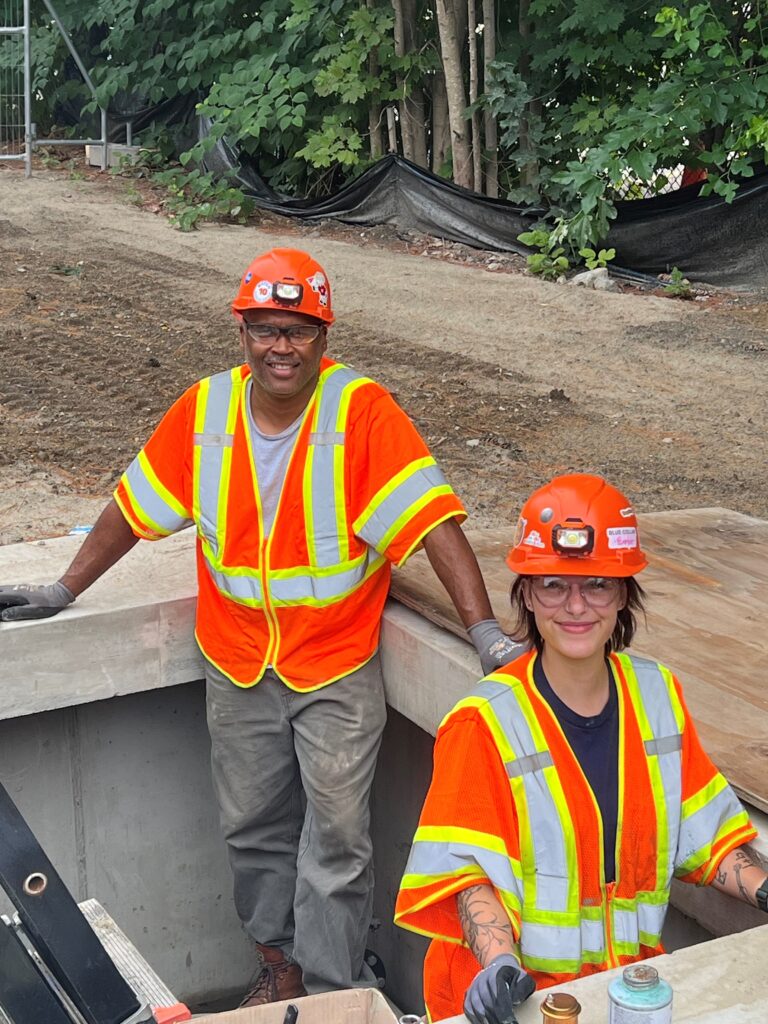 Utility pipefitters on the job in Framingham, Massachusetts. Image credit: Eversource Energy.
Building Momentum and Trust
Luz and Framingham city staff had cultivated early neighborhood interest in the microgrid project, but they were careful not to over-promise on a geothermal network. Even if the neighborhood was selected, they had no idea which streets and buildings would be included in the network’s final design. “To do all of that buildup and then have a project fall flat made us nervous,” Luz says. “In the beginning, I just wanted to make sure that the key property owners were on board and knew the vision, and I told them we’d do our best to bring the project here.”
In 2022, it became official: Eversource selected Framingham as the site for its first utility-owned geothermal loop. Now community-wide outreach began in earnest.
Every department of the gas utility was involved. The gas sales team, rebranded as the “thermal solutions” team, hit the streets to knock on doors. Within the first weekend of community canvassing, Eversource collected 40 signed letters of interest from neighborhood residents. One resident even ran after the departing sales van to get a yard sign that would promote the geothermal loop.
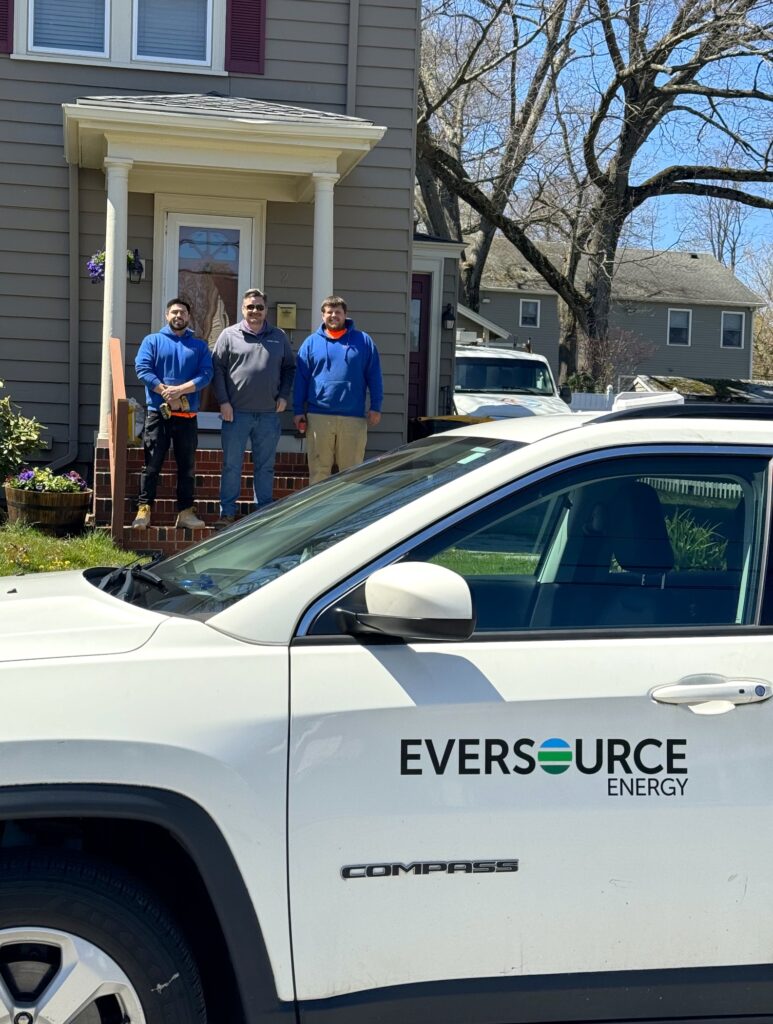
In-home installation work begins. Image credit: Eversource Energy.
Due to the city’s previous community outreach around clean energy, many residents were already interested in home electrification, Luz says, and they could recognize what he describes as the “exceptional financial opportunity” to upgrade to geothermal heat pumps at no cost by participating in the pilot. Still, the concept of a utility-owned geothermal network was new. “Eversource really communicated that this is a new context for a technology that is already widely used,” Luz says. “Geothermal is not new—piloting a utility network is what’s new. That was a huge part of their messaging in customer meetings.”
Luz credits Eversource for leading strong community engagement over months, including hosting science events with a local school and regularly tabling in the neighborhood. But questions about the nature and duration of the pilot still remained.
“If you’re a homeowner, the first thing in your mind is: ‘What happens if it doesn’t work?’” Luz says. A factor that eased outreach was the protection built into the pilot’s regulatory approval: residents could choose to revert their homes’ heating and cooling systems to their previous appliances if the pilot project was discontinued, at no cost to them.
As Luz puts it, “I could sleep knowing that in the worst-case scenario, we could make residents right.”
Tackling the Building Stock
As construction began, one of the toughest—and most unexpected—challenges was confronting deferred maintenance in buildings.
“We found mold, asbestos, old electrical wiring,” recalls Bruno. Making buildings code-compliant meant replacing panels and circuits before geothermal could even be installed. These issues aren’t specific to geothermal networks, but they do decrease the speed and complicate the costs of decarbonization. Finding reliable, recurrent funding for retrofits will be crucial to success in future projects across the nation.
“There’s currently not a tactic, or clear funding stream, for fixing mold, asbestos, faulty wiring, code violations,” says Magavi. “These repairs deliver huge health and efficiency benefits. But we need to make them part of the financing layer cake—otherwise, it will get in the way of scaling.”
Drilling For Geothermal, Building A Market
“Anyone who has done construction knows there’s no project without some daily unexpected element,” says Magavi. But she was impressed by how smoothly gas utility workers transitioned to laying geothermal pipes. “It was flawless—switching to geothermal pipes for a few months, then returning back to their gas pipeline jobs.”
Drilling geothermal boreholes, however, was more difficult. The Northeast lacks a robust geothermal drilling workforce, and experienced crews are booked months in advance, causing project delays.
To address this, Home Energy Efficiency Team (HEET) is helping prepare the industry for expansion in the Northeast. In September 2024, the organization partnered with the Geothermal Drillers Association and International Ground Source Heat Pump Association to host a free two-week drilling tutorial aimed at Boston-area high school students, and has advocated for the establishment of regional Geothermal Drilling Centers of Excellence to solve worker and equipment shortages. HEET is also partnering with local unions to ramp up the driller training force for the future.
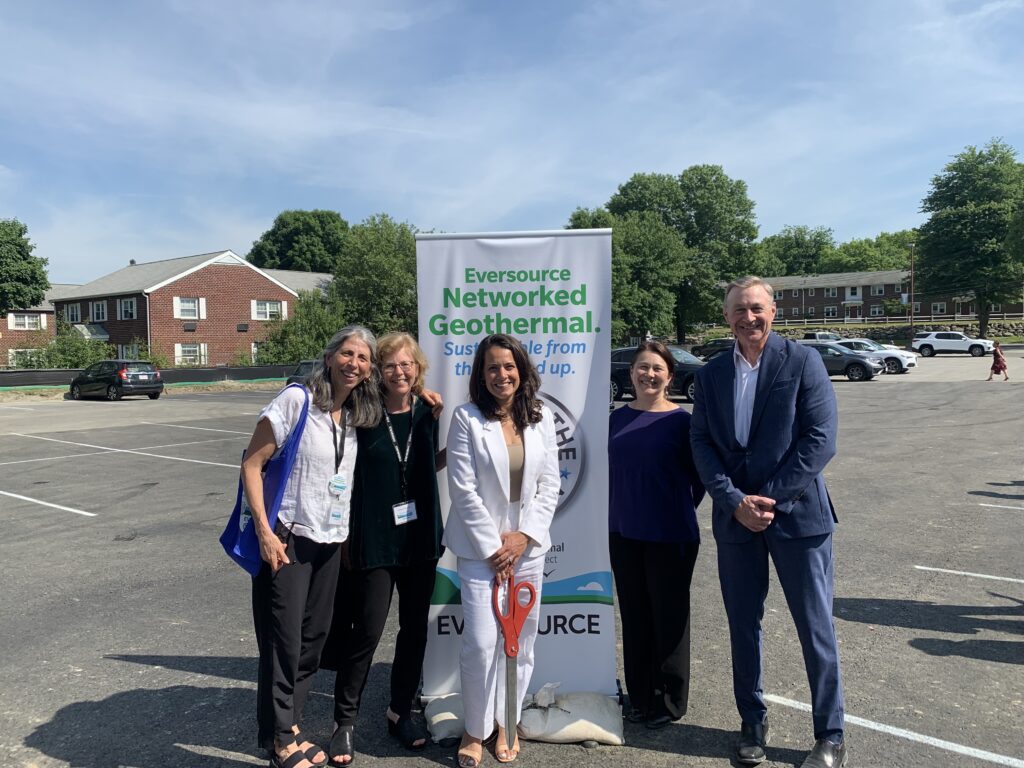
The official ribbon-cutting of Eversource’s geothermal network in June 2024. Left to right: Ania Camargo Cortés, Audrey Schulman, Nikki Bruno, Zeyneb Magavi, Bill Akley
The Geothermal Network Goes Live—and Expands
In June 2024—with all boreholes drilled and geothermal pipes laid—Eversource executives joined Framingham staff and officials, HEET team members, and community residents to officially cut the ribbon on Framingham’s geothermal network.
With that, Framingham was now home to the nation’s first utility-owned geothermal network. Customers continued to join in stages. By July, the Learning From the Ground Up (LeGUp) research team, comprising multiple project stakeholders, had begun data collection. The LeGUp team will monitor the geothermal network throughout its two-year pilot duration, analyzing cost, smoothness of operation, customer satisfaction, and emissions reductions, then publishing their findings.
Even as the first geothermal loop of pipes neared completion, the team was planning for expansion. In April 2023, the Department of Energy’s Community Geothermal Initiative had awarded HEET and the project team a $715,000 grant to plan an expansion of the network and the feasibility of a second loop. The following November, just a few months after the ribbon-cutting of the first loop, the team secured a second round of support from the Department of Energy. This time, the agency awarded a $7.8 million grant to extend the loop to additional homes and buildings..
The expansion supports the increased local demand: “One of our challenges is that we can’t grow the network fast enough,” Luz says.
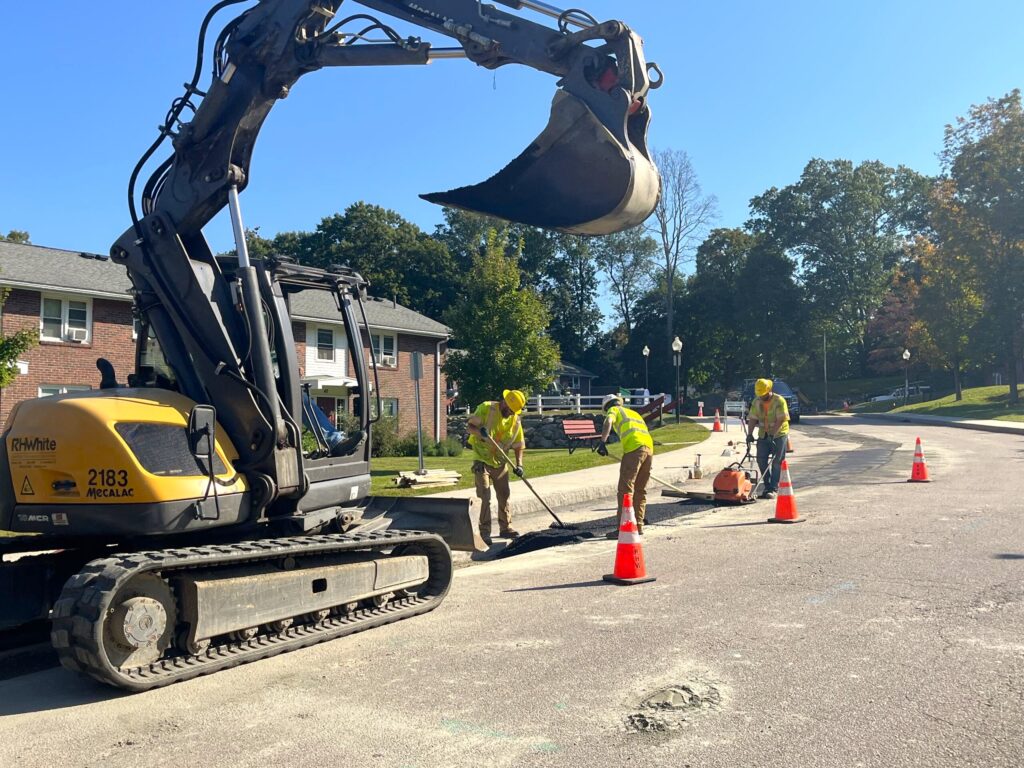
Geothermal pipeline is installed in Framingham. Photo credit: Eversource Energy.
Economies of Scale: Comparing Costs
Expanding the network has already revealed opportunities for cost savings. The first loop’s total costs are still being tallied as customers continue to join the network, but the first pilot is estimated to cost roughly $22 million, with the opportunity to be reduced after applying Inflation Reduction Act tax credits (if available).
Remarkably, the geothermal pipe installation costs were nearly exactly the same as equivalent gas infrastructure: “Our mains and services for geothermal came in spot-on for pipe replacement,” says Bruno. “It’s pretty incredible, on your first try, to get something that looks so similar.”
The second loop is similar in size, but on track to cost approximately 60% of the first, according to Eric Bosworth, the company’s former Manager of Clean Technologies, when interviewed earlier this year. (Bosworth has since founded a consulting firm specializing in utility-scale thermal energy networks). That’s partly because some costs—like the pump house and civil work—don’t need to be repeated. Design work is also becoming more efficient, incorporating existing plans and lessons from the first loop.
“Our mains and services for geothermal came in spot-on for pipe replacement. It’s pretty incredible, on your first try, to get something that looks so similar.”
Nikki Bruno, Vice President for Clean Energy Solutions, Eversource Energy
What Do Residents Pay?
Eversource covered all behind-the-meter construction costs for the pilot, including purchasing, installing and connecting geothermal heat pumps for customers. As the pilot proceeds, the utility will also handle heat pump maintenance, such as routine filter changes, throughout the pilot period.
Customers will pay a monthly service fee based on a budget billing model for the duration of the pilot. This fee is designed to promote equity, and is approximately:
- Income-eligible households: ~$8/month
- Other residential customers: ~$10/month
- Commercial customers: ~$20/month
“This is a pilot, not a program to make revenue off of,” explains Liam Needham, Eversource’s Director of Thermal Solutions. Eversource has been considering equitable approaches on charging for usage, including both flat-rate and volumetric models, but long-term decisions will depend on the system’s data and financial performance.
Inspiring Others, Looking Ahead
“The first project in Framingham wasn’t just about one network. It’s about open-source learning,” says Magavi. “If we make the pipe size bigger, does efficiency go up? If we tweak the design, who ends up paying more—the utility or the customer?” The LeGUp team hopes to collect the data needed to guide the adoption of geothermal networks across the country. Those lessons are already rippling out, as more states pass laws to allow utilities to operate thermal energy networks.
And for residents, the impact is personal. Magavi recalls one homeowner’s review: “He said, ‘Yeah, the heating and cooling works fine. But what I really like is I can look out the window and get more sunlight because the AC unit is gone.”
A quieter home, a sunnier view—just two of the benefits of a new kind of energy system, built from the ground up.
Thank you to Shawn Luz, Nikki Bruno, Eric Bosworth, Liam Needham, Zeyneb Magavi, Tony Berry, and Andrew Iliff for your contributions to this case study.